How do automatic door motors and anti-pinch sensors work together
The ventilation cabinet sash can be designed with electric automatic lifting and lowering in addition to manual sliding. Operators do not need to repeatedly lift and push it; when holding experimental equipment, they can use buttons or foot pedals to control the opening and closing. In case of sudden harmful substance leakage, the window can be quickly lowered to close the operating opening. This automatic lifting and lowering mechanism for the sash achieves both usability and safety through the coordination of three components: the automatic door motor, transmission and guidance mechanism, and anti-pinch sensors. An electric sash without anti-pinch protection cannot be put into use.
What does the automatic door motor do
The automatic door motor is the power source for the sash lifting and lowering. It drives the sash to move smoothly up and down along the guide rails through transmission methods such as hoisting, lead screws, or synchronous belts. The motor is equipped with limit switches and brakes, allowing the sash to stop at any position and preventing it from sliding down when power is cut. The sash has its own weight, and rails and cables will age in corrosive environments. The motor's torque and transmission components must be configured according to the sash size, weight, and anti-corrosion requirements. Small-power motors cannot forcibly drive large sashes.
How does the anti-pinch sensor protect
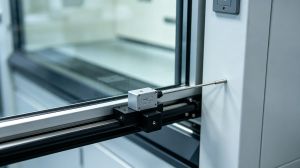
The anti-pinch sensor detects obstacles along the sash lowering path. Once the sash encounters a person's hand, experimental equipment, or abnormal resistance, it immediately stops the motor and reverses the movement slightly to avoid injury or breaking the equipment. It can be a contact-type pressure-sensitive edge or a non-contact-type sensing element. Typically, it forms a complete protective belt along the bottom edge of the sash, rather than just protecting a single point.
The anti-pinch function must be coordinated with the motor control: if the resistance threshold is set too high, protection will not take effect; if it is set too low, the sash may frequently stop due to normal friction. After installation, test repeatedly with simulated obstacles at different positions of the sash to confirm that it stops and reverses at any point of resistance.
How does it link with variable air volume control
The sash position signal is simultaneously supplied to the variable air volume controller. When the sash moves, the damper adjusts synchronously to maintain a constant face velocity. When the experiment ends or an alarm is triggered, the sash can be automatically closed with one button, and the system switches to a low airflow state while maintaining the cabinet's negative pressure. The automatic door motor, anti-pinch sensor, displacement sensor, and variable air volume damper should be considered as a complete system during selection. Interfaces and action sequences must be unified to avoid malfunctions caused by mismatched components. Regularly test the lifting and lowering, anti-pinch, and emergency stop functions, clean crystallization from the rails, and promptly repair any sash sticking or delayed rebound.