
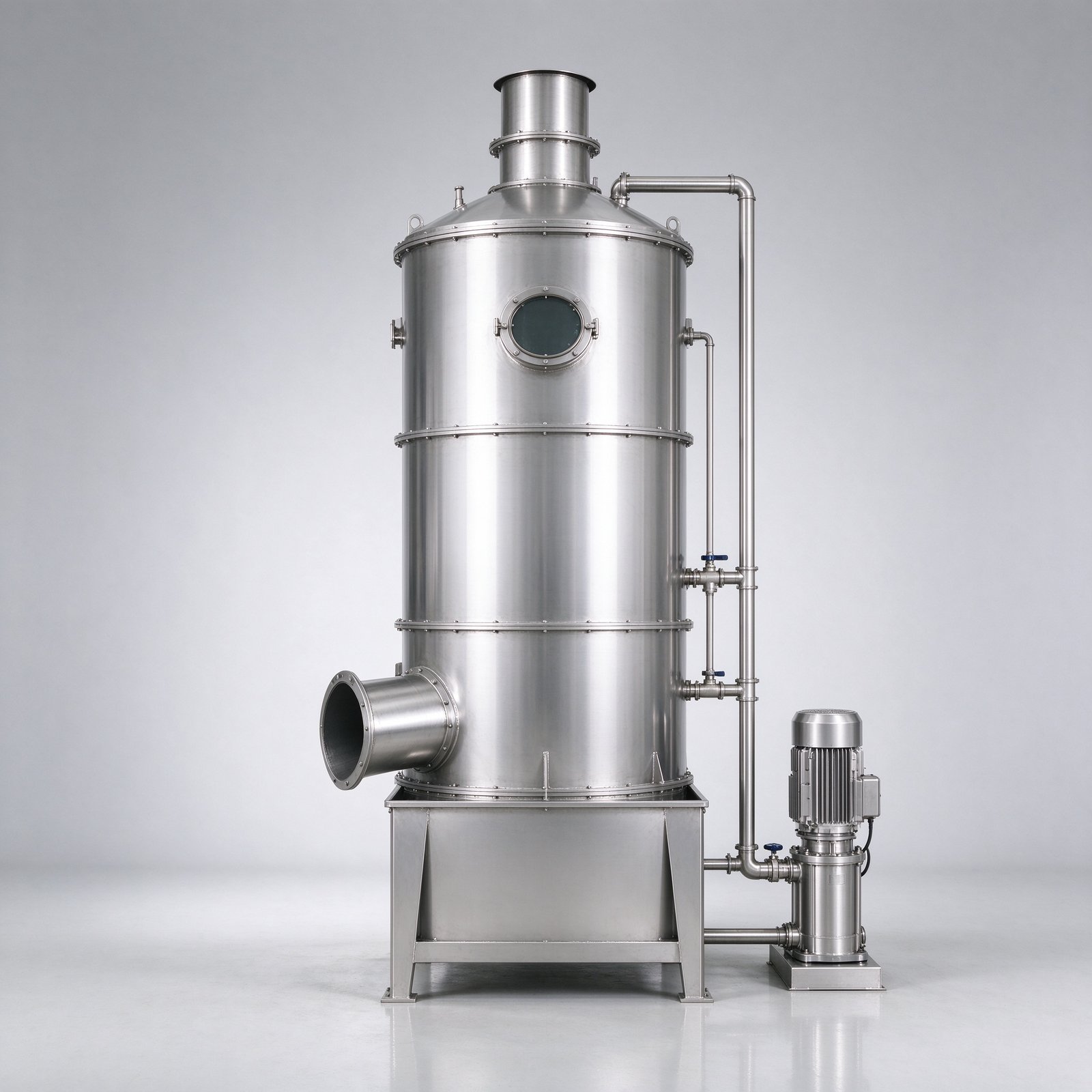
Stainless steel spray tower
| Product Model | Stainless steel series (Ø800–Ø3000) |
|---|---|
| Category | Stainless steel product series |
| Reference Price | Price on request |
Product Overview
The stainless steel spray tower, also known as stainless steel scrubber, is a vertical wet scrubber made by rolling and welding stainless steel plates, primarily used for treating acidic, alkaline, and high-temperature corrosive exhaust gases. The exhaust gas enters the tower from the bottom inlet, flows through the packing layer to come into reverse contact with the spray absorption liquid for neutralization, and then passes through the stainless steel mesh demister for dehydration before exiting through the top exhaust stack. The absorption liquid falls into the water tank for recirculation and spraying. The equipment features a welded metal structure with mirror or brushed finish, offering superior rigidity and pressure-bearing capacity compared to plastic towers.
The tower body is typically constructed from 304 or 316L stainless steel plates, bent into segments and welded with longitudinal and circumferential seams before being polished as a whole. The welds are smooth, and the inner wall is smooth, making it resistant to scaling and easy to clean. The 304 stainless steel spray tower is suitable for general acid, alkaline, and conventional corrosive conditions, while the 316L, containing molybdenum, offers stronger resistance to chloride pitting corrosion and is ideal for applications with chlorine, salt spray, or more severe corrosion. The tower is equipped with stainless steel circulating water pipes, valves, manholes, sight glasses, ladders, and inspection platforms. The inlet and outlet airflows are connected via flanges.
Compared to PP plastic towers, the stainless steel anti-corrosion spray tower offers higher temperature resistance, does not soften easily at higher inlet temperatures, and exhibits better anti-aging, UV resistance, and mechanical damage resistance. Outdoor and large-diameter tower structures are more stable. Standard tower diameters range from φ800 to φ3000 and can be configured as single towers or multi-stage series arrangements, or as horizontal or non-standard structures. It can be used alone for acid mist washing or as a pre-cooling treatment for high-temperature exhaust gas purification and organic exhaust gas before entering activated carbon or regenerative thermal oxidation.
Working Principle
Contaminated gas enters the tower from the tangential inlet at the bottom, first passing through an evenly distributed space to reduce velocity, and then rising through the packing layer. The recirculation pump delivers the absorption liquid from the bottom tank to the upper spray pipes, where multiple nozzles spray it downward uniformly, forming a continuous liquid film on the packing surface. The rising gas comes into reverse contact with the descending liquid droplets, where gaseous acid and alkaline pollutants are captured and neutralized by the absorption liquid, while dust and soluble substances are carried away by the liquid droplets.
After scrubbing, the gas carries a significant amount of liquid droplets and continues upward into the mesh demister. The liquid droplets collide and coalesce into larger droplets on the mesh before falling back into the tower. The dehydrated gas is then drawn out through the top exhaust stack by a fan. The liquid absorbing pollutants flows to the bottom tank, where chemicals, water, or replacement are added or changed based on pH and concentration. The recirculation pump ensures closed-loop circulation, reducing water and chemical consumption. For applications with more dust or viscous gases, swirl plates can be added or the packing and spray combination adjusted to enhance dust removal and prevent blockages.
Structural Components
The tower, from bottom to top, consists of a tangential inlet, a recirculation water tank, packing support and packing layer, spray section, mesh demister section, and top exhaust stack, with external components including a recirculation pump, water pipes, valves, manholes, sight glasses, ladders, and inspection platforms. The bottom tank stores the absorption liquid and includes interfaces for water replenishment, discharge, overflow, and chemical dosing. The packing layer is supported by grating plates and filled with multi-faceted hollow balls or Raschig rings to increase gas-liquid contact area. The spray section features two or more layers of nozzles, ensuring uniform coverage and minimizing dead zones.
The upper demister section is equipped with a stainless steel mesh demister to remove liquid droplets carried by the outlet gas and protect the downstream fan. Several circular manholes and glass sight glasses are installed along the tower height for observing the spray and packing conditions and for maintenance access. All pipe connections, manholes, and flanges are welded or connected with flanges, ensuring reliable sealing. The entire tower is connected in segments via flanges, facilitating segmented transportation, on-site assembly, and later packing replacement or nozzle maintenance.
Specification Model Table
The table below shows the standard tower diameters for stainless steel spray towers. The tower diameter is selected based on airflow and empty tower velocity, with the spray section, packing layer, and demister section configured in segments according to the tower diameter. Actual plate thickness, material grade, inlet/outlet dimensions, and water tank volume are designed individually based on exhaust composition, temperature, airflow, and site conditions. The table provides conventional structural configurations and dimensions.
| Specification Model | Tower Diameter (mm) | Spray Section | Packing Layer | Demister Section | Maintenance Configuration |
|---|---|---|---|---|---|
| φ800 | 800 | 2/1 | Hollow Ball/Raschig Ring | Mesh Demister | Manhole Sight Glass |
| φ1000 | 1000 | 2/1 | Hollow Ball/Raschig Ring | Mesh Demister | Manhole Sight Glass |
| φ1200 | 1200 | 2/1 | Hollow Ball/Raschig Ring | Mesh Demister | Manhole Sight Glass |
| φ1500 | 1500 | 2/1 | Hollow Ball/Raschig Ring | Mesh Demister | Manhole Sight Glass |
| φ1800 | 1800 | 2/1 | Hollow Ball/Raschig Ring | Mesh Demister | Manhole Sight Glass |
| φ2000 | 2000 | 2/1 | Hollow Ball/Raschig Ring | Mesh Demister | Manhole Sight Glass |
| φ2200 | 2200 | 2/1 | Hollow Ball/Raschig Ring | Mesh Demister | Manhole Sight Glass |
| φ2500 | 2500 | 2/1 | Hollow Ball/Raschig Ring | Mesh Demister | Manhole Sight Glass |
| φ2800 | 2800 | 2/1 | Hollow Ball/Raschig Ring | Mesh Demister | Manhole Sight Glass |
| φ3000 | 3000 | 2/1 | Hollow Ball/Raschig Ring | Mesh Demister | Manhole Sight Glass |
The tower is connected in segments via flanges, standardly equipped with a recirculation pump, spray pipes, valves, sight glasses, manholes, and water replenishment/discharge interfaces. Dimensions can be designed based on site conditions and airflow.
Product Features
While maintaining wet scrubbing efficiency, the stainless steel spray tower highlights the advantages of metal material in terms of temperature resistance, strength, and durability, primarily demonstrated in the following aspects.
- Stainless steel plates are rolled and welded, offering excellent overall rigidity and pressure-bearing capacity, making large-diameter towers less prone to deformation
- Superior temperature and fire resistance compared to plastic towers, suitable for higher inlet temperatures and long-term outdoor applications
- Polished inner wall is smooth, resistant to scaling and fouling, and easier to clean and replace packing
- Two material grades, 304/316L, are available to suit different chloride content and corrosion intensity conditions
- Multi-layer spraying combined with packing and mesh demisters ensures thorough gas-liquid contact with minimal liquid carryover at the outlet
- Flange segment connections, complete with manholes, sight glasses, ladders, and platforms, facilitate easy maintenance
- Closed-loop absorption liquid circulation reduces water and chemical consumption, making it compatible with various exhaust gas treatment systems
| Main material | 304/316L stainless steel |
|---|---|
| Tower structure | Vertical cylindrical |
| Manufacturing Process | Tube welding, overall polishing |
| Surface Treatment | Mirror or brushed finish |
| Standard Tower Diameter Range | φ800–φ3000 |
| Inlet method | Bottom tangential airflow |
| Spray Layer Form | Multi-layer nozzles spray |
| Type of packing | multi-faceted hollow ball, Raschig ring |
| Demisting method | Stainless steel wire mesh demister |
| Recirculation Mode | Pump closed-loop recirculation sprinkling |
| Pipe connection | Flange connection |
| Maintenance configuration | 人孔、视镜、爬梯平台 |
| Object processing | Acid-alkali exhaust gas, acid mist, high-temperature corrosion gas |
| Installation method | Suitable for indoor and outdoor use |
Application Industries
- Treatment of acidic and alkaline exhaust gases such as sulfuric acid mist, hydrochloric acid mist, and alkali mist in chemical production
- Purification of acid mist and chromium-containing acid mist gases in electroplating and surface treatment acid washing lines
- Washing of high-temperature flue gas and acidic/alkaline gases generated in metallurgical and heat treatment processes
- Purification of high-temperature acidic/alkaline exhaust air in etching processes of semiconductor and electronics industries
- Absorption and treatment of acidic/alkaline exhaust gases in reaction feeding processes of pharmaceutical and food industries
- Pre-cooling and dust removal of organic exhaust gases from coating and printing before deep treatment
- Centralized washing of exhaust air from laboratories and workshops with fireproof and high-temperature resistance requirements
Typical Process Locations
The stainless steel spray tower is usually connected after the exhaust hood, exhaust branch duct, and main duct. Pollutant-containing gases are first collected via ducts into the tangential inlet at the lower part of the tower, where absorption, washing, and mist removal are completed inside the tower. The purified gas is then drawn away through the top exhaust stack by a corrosion-resistant fan. When the exhaust gas contains adsorbable organic substances, an activated carbon adsorption unit or regenerative thermal oxidation (RTO) can be connected after the tower for deep treatment, with the spray tower responsible for pre-cooling, dust removal, and mist removal. For high-temperature flue gas, the stainless steel tower can be directly placed near the production line to reduce cooling investment for high-temperature gas in plastic pipes and equipment.
During on-site installation, the tower body is connected to upstream and downstream ducts, fans, and circulating water pipes via flanges. The bottom water tank is connected to water replenishment, chemical dosing, and wastewater discharge pipelines, with the circulating water pump installed close to the tower to shorten pipe lengths. If the exhaust gas composition is complex or the concentration is high, a two-stage spray tower in series or segmented washing with alkali or oxidizing solutions can be used. The tower diameter and circulation rate are designed based on the treatment airflow. Xicheng Environmental Protection can provide complete sets of stainless steel spray towers, corrosion-resistant fans, pumps, duct dampers, and downstream activated carbon equipment, along with engineering design, equipment manufacturing, and installation and commissioning services.
Get Quote
Stainless steel spray tower / Stainless steel series (Ø800–Ø3000)