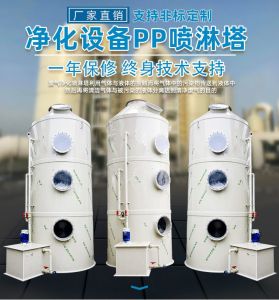
Which is better between a swirl tower and a spray tower? Select based on pollutant type: swirl tower handles ≥10μm dust with ≥95% efficiency, spray tower treats acid mist with ≥90% efficiency.
Which is Better: Swirl Tower or Spray Tower? Choose by Pollutant Type

Which is better between a swirl tower and a spray tower? Choose based on the type of pollutant: swirl towers are suitable for dust particles ≥10μm, with a dust removal efficiency of ≥95%; spray towers are suitable for acid mist, with a purification efficiency of ≥90%.

Core Working Principle Differences

A swirl tower uses centrifugal force from rotating air flow to throw dust particles ≥10μm onto the tower wall for sedimentation, achieving dust removal. A spray tower atomizes liquid to contact and adsorb pollutants like acid mist in exhaust gas, completing purification.

Key Performance Parameters Comparison

ParameterSwirl TowerSpray Tower
Suitable Pollutant TypeDust particles ≥10μmAcid mist
Core Purification EfficiencyDust removal efficiency ≥95% for particles ≥10μmPurification efficiency ≥90%
Tower MaterialFlame-retardant PP/PPs, flame retardant grade B1Flame-retardant PP/PPs, flame retardant grade B1

Selection Tips by Pollutant Type

For dust particles ≥10μm, prioritize a swirl tower for its higher dust removal efficiency. For acid mist or other gaseous pollutants, a spray tower is more suitable as it meets purification efficiency standards. Both products belong to the main business of Huizhou Xicheng Environmental Technology Co., Ltd., a subsidiary of Xicheng Environmental Group. The group has over 30 branches and production bases nationwide, expanded to Vietnam in 2023. It holds ISO9001, ISO14001 certifications, is a high-tech enterprise with 100+ national patents, and collaborates with Xi'an Jiaotong University, Tongji University, and China University of Mining and Technology. Production equipment includes laser engraving machines, automatic fusion welding machines, and injection molding machines, enabling mechanized mass production to ensure stable product quality. These equipment are applied in industries like PCB, electroplating, chemical, pharmaceutical, food, electronics, textile, rubber and plastic, automotive, cement, and ceramics.

Related FAQs

PP spray towers are widely used in the waste gas treatment fields of multiple industries such as PCB, electroplating, chemical industry, pharmaceutical, food, electronics, textile, rubber and plastic, automobile, cement, ceramics, etc., especially suitable for acid-base waste gas treatment.
When selecting a spray tower, factors such as treatment air volume, exhaust gas composition, concentration, temperature, and purification efficiency requirements need to be considered. Xicheng Environmental Protection has a professional technical team that can provide customized solutions based on your working conditions. Consultation Tel: 18038067815.
The purification efficiency of the spray tower depends on factors such as exhaust gas composition, concentration, spray liquid formulation, tower structure design, etc. Generally, the purification efficiency of acid-base exhaust gas can reach more than 90%. Xicheng Environmental Protection has rich engineering experience and can design the optimal solution according to your specific working conditions.
The PP Cyclone Tower is a wet dedusting and purification equipment. The exhaust gas is introduced into the tower through ducts and, as it passes through multiple swirl blades, undergoes counter-rotating liquid spraying: clockwise blades in the first layer and counterclockwise blades in the second layer. The alternating collision of the gas phases enhances the separation of dust or paint mist residue through inertial collision, centrifugal separation, and liquid film adhesion, causing them to flow into the bottom of the tower. The swirl device utilizes the kinetic energy of the flue gas to generate aerodynamic swirl, enabling thorough contact between the gas and liquid phases for mass transfer reactions. The purified gas is then discharged by the fan after dehydration and mist removal in the third layer's mist separator. The absorption liquid falls to the bottom of the tower, where it is pressurized by a pump and recirculated for spraying.
Both are wet exhaust gas purification equipment, but their internal structures and applicable conditions differ. Standard spray towers rely on a packing layer to increase gas-liquid contact area, suitable for conventional acid-base waste gas and acid mist treatment, but viscous waste gas and dust can easily cause packing blockage. Cyclone towers utilize centrifugal separation generated by multi-layer swirling vanes and liquid film adhesion to remove dust, making them more suitable for viscous exhaust gas such as paint mist and conditions with higher dust content, and less prone to blockage. Cyclone towers have relatively higher resistance, requiring matching fans with higher pressure when selecting.
The cyclone tower is primarily used for treating paint mist, viscous exhaust gas, and dust-laden exhaust gas, such as paint mist exhaust gas in the coating spraying industry, dust-containing exhaust gas in the metal grinding and polishing industry, dust exhaust gas in the building materials and cement industry, wood dust and paint mist exhaust gas in the woodworking and furniture industry, and smoke and dust exhaust gas in the rubber and plastic industry. For conventional acid-base exhaust gas, a standard packed tower can be selected; for high-concentration or difficult-to-treat exhaust gas, a series configuration of cyclone tower and packed tower or a multi-stage cyclone tower combination process can be adopted. For exhaust gas containing organic pollutants, an activated carbon adsorption box can be connected in series after the cyclone tower for deep treatment.
The cyclone tower is available in two types: packed and unpacked. The unpacked type consists of multiple cyclone plates and a spray layer as its core components, featuring a simple structure, low pressure drop, and completely avoiding the maintenance challenges of packed bed clogging. It is primarily used for treating viscous, oily, or fiber-containing exhaust gases, or in scenarios where only dust removal and cooling are required. The packed type consists of cyclone plates, a packing layer, and a spray layer as its core components, mainly used for treating non-viscous, non-clogging exhaust gases, which can further enhance gas-liquid contact area and purification efficiency. The specific selection should be determined based on the nature of the exhaust gas.
In organic waste gas treatment systems, cyclone towers are typically used as front-end pretreatment equipment to first remove paint mist, dust, and particulates from the waste gas, preventing these substances from clogging the downstream activated carbon adsorption layer and extending the service life of the activated carbon. After pretreatment by the cyclone tower, the waste gas enters the activated carbon adsorption box for deep purification to remove VOC organic pollutants. The typical process involves: waste gas collection by hood, followed by dust removal and washing in a PP cyclone tower, then adsorption and purification in an activated carbon adsorption box, and finally discharge through a PP fan via an exhaust stack in compliance with emission standards.
The selection primarily requires the following parameters: First, the nature of the exhaust gas, including pollutant composition, concentration, whether it contains viscous substances or dust; second, the treatment air volume, measured in cubic meters per hour; third, the exhaust gas temperature and humidity; fourth, the on-site installation space, including height and footprint limitations; fifth, the required purification efficiency and the applicable emission standards; sixth, material preferences. Providing these parameters allows for matching the tower diameter, number of swirl blade layers, and circulating water pumps. Standard tower diameters cover φ800 to φ3000, and non-standard designs are available for special conditions.
The circulating liquid in the cyclone tower requires regular maintenance to ensure purification efficiency. During operation, the pH and suspended solids concentration of the circulating liquid should be checked regularly. When dust or paint mist sediment accumulates excessively in the circulating liquid, the circulating liquid should be replaced promptly, and the sediment at the bottom of the tower should be cleaned. It is recommended to configure a water replenishment and drainage device for regular effluent discharge and water replenishment. The circulating liquid should be avoided from being discharged arbitrarily and must be discharged after being treated in accordance with environmental protection requirements. Meanwhile, it is necessary to regularly check whether the spray nozzles are blocked and whether the swirl vanes are coated with dust, and perform timely cleaning and maintenance. During winter operation, attention should be paid to anti-freezing. When necessary, insulation measures should be taken or the circulating liquid should be drained regularly.

Related Products

PP Swirl Tower

PP Swirl Tower

Price on request
PP-X 系列(φ800-φ3000) View Details