
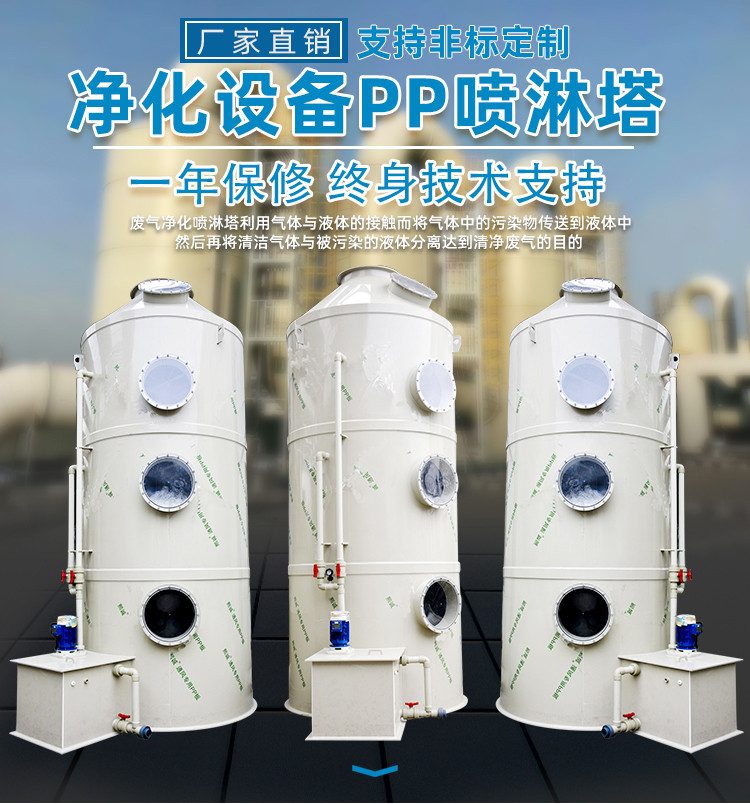
PP Swirl Tower
| Product Model | PP-X Series (φ800-φ3000) |
|---|---|
| Category | Waste Gas Treatment Equipment |
| Reference Price | Price on request |
Product Overview
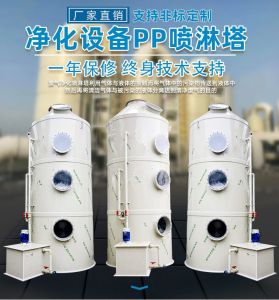
The PP Cyclone Tower, also known as a Cyclone Plate Tower, Cyclone Purification Tower, or Cyclone Dust Removal Tower, is a wet scrubbing device designed for paint mist, viscous exhaust gas, and dusty conditions. The exhaust gas is introduced into the tower through ductwork and passes through multiple cyclone vanes and the spray system. Utilizing the inertia collision, centrifugal separation, and liquid film adhesion between particles and droplets, dust or paint sludge is collected at the bottom of the tower, while purified gas is dehumidified by an demisting section before being discharged into the atmosphere via a fan. The equipment is fabricated from corrosion-resistant, acid/alkali-resistant, UV-resistant, and flame-retardant PP materials. It features a rational structure and stable operation, making it a commonly used device for exhaust gas treatment in industries such as painting, spray coating, and metal grinding.
Working Principle
The Cyclone Tower incorporates a multi-layer cyclone vane structure, replacing the packing layer of traditional spray towers to fundamentally prevent clogging caused by viscous exhaust gas and dust. The first layer of cyclone vanes uses clockwise spray, while the second layer uses counterclockwise spray. The alternating clockwise and counterclockwise gas phases enhance the inertia collision, centrifugal separation, and liquid film adhesion, causing dust or paint sludge to flow into the tower bottom. Multiple cyclone units are designed inside the tower. The primary purified flue gas rises in a rotating motion. The cyclone aerodynamic device provides guidance and assistance, generating aerodynamic cyclones using the inherent kinetic energy of the flue gas for efficient gas-liquid contact and mass transfer. The third layer is the demisting header, which removes moisture and mist to prevent liquid from being carried out with the gas.
Structural Components
The equipment, from bottom to top, primarily consists of an inlet, a liquid storage tank, a circulation pump, cyclone vane layers, a spray system, inspection windows, a demisting header, and an outlet. The cyclone vanes replace the packing layer of traditional spray towers, eliminating clogging issues caused by viscous exhaust gas and dust. The spray system features multi-layer nozzles for uniform spray distribution. The demisting header removes moisture and mist, reducing liquid carryover to protect downstream fans. Standard equipment includes spray pipes, ball valves, flow meters, differential pressure gauges, tank covers, water replenishment and drainage kits, and high-flow pumps. All components are designed in standardized modular configurations, ensuring easy on-site installation and maintenance.
Tower Type Comparison
The core difference between the Cyclone Tower and conventional packing spray towers lies in their internal structures. Conventional spray towers rely on packing layers to increase gas-liquid contact area, suitable for general acid/alkali gases and acid mists. Cyclone Towers utilize centrifugal separation and liquid film adhesion generated by cyclone vanes, making them more suitable for viscous exhaust gases like paint mist and dusty conditions while minimizing clogging. Cyclone Towers are available in two types: fill-free and fill-added. The fill-free type consists of multi-layer cyclone plates and a spray layer, offering a simple structure with lower pressure drop. The fill-added type includes cyclone plates, packing layers, and a spray layer, suitable for non-viscous, non-clogging exhaust gas treatment. Selection can be tailored to exhaust gas properties.
Specification Model Table
| Model | Tank Body (mm) | Base Plate (mm) | Spray Layers | Cyclone Vanes | Demisting Layer | Inspection Window Size (mm) | Outlet (mm) |
|---|---|---|---|---|---|---|---|
| φ800 | 8 | 8 | 2/1 | Counter-rotating | Header | φ400 | φ315 |
| φ1000 | 8 | 10 | 2/1 | Counter-rotating | Header | φ400 | φ355 |
| φ1200 | 8 | 10 | 2/1 | Counter-rotating | Header | φ400 | φ400 |
| φ1500 | 8 | 10 | 2/1 | Counter-rotating | Header | φ500 | φ500 |
| φ1800 | 10 | 10 | 2/1 | Counter-rotating | Header | φ500 | φ600 |
| φ2000 | 10 | 12 | 2/1 | Counter-rotating | Header | φ500 | φ650 |
| φ2200 | 10 | 12 | 2/1 | Counter-rotating | Header | φ500 | φ700 |
| φ2500 | 12 | 12 | 2/1 | Counter-rotating | Header | φ500 | φ800 |
| φ2800 | 12 | 15 | 2/1 | Counter-rotating | Header | φ500 | φ900 |
| φ3000 | 12 | 15 | 2/1 | Counter-rotating | Header | φ500 | φ1000 |
The above are ten standard models. Standard equipment includes spray pipes, ball valves, flow meters, differential pressure gauges, tank covers, water replenishment and drainage kits, and high-flow pumps. Cyclone vane layers and structures can be customized based on exhaust gas properties, with non-standard customization available for special conditions.
Product Features
- Uses PP/PPs flame-retardant materials, acid/alkali-resistant, UV-resistant, and flame-retardant, with long service life
- Multi-layer counter-rotating cyclone vanes for centrifugal separation and liquid film adhesion, achieving high dust removal efficiency
- Cyclone vanes replace packing layers, minimizing clogging and suitable for viscous exhaust gas and dusty conditions
- Demisting header removes moisture, reducing liquid carryover to protect downstream fans
- Absorption liquid is recycled, reducing water and chemical consumption for lower operating costs
- Comprehensive standard models available, with non-standard customization based on site conditions
| 主体材质 | PP/PPs 阻燃聚丙烯 |
|---|---|
| 塔型结构 | 旋流叶片式 |
| 板材特性 | 防腐、耐酸碱、抗 UV、阻燃 |
| 标准规格范围 | φ800-φ3000 |
| 桶身壁厚 | 8-12mm |
| 底板厚度 | 8-15mm |
| 旋流叶片结构 | 头层顺时针加二层逆时针双向喷淋 |
| 除雾方式 | 除雾大小头脱水除雾 |
| 视窗规格 | φ315/φ400/φ500 |
| 出风口规格 | φ315-φ1000 |
| 处理对象 | 漆雾、粘性废气、含粉尘废气 |
| 塔型 | 立式 |
| 安装方式 | 室内外均可 |
Application Industries
- Pre-treatment of paint mist and sticky exhaust gas in coating and spray painting industries
- Exhaust gas treatment containing dust in metal grinding and polishing industries
- Production dust exhaust gas treatment in building materials and cement industries
- Exhaust gas treatment containing wood chips and paint mist in woodworking and furniture industries
- Exhaust gas treatment containing flue gas and dust in rubber and plastic industries
- Exhaust gas treatment containing grease and dust in food processing industries
- Dust-containing exhaust gas washing and purification in chemical and metallurgical industries
Typical Process Location
The typical exhaust gas treatment process involves collecting exhaust gas through hoods or ducts, which first enters a PP swirl tower for dedusting, cooling, and washing. Then, based on the pollutant composition, it proceeds to deep treatment equipment such as activated carbon adsorption boxes. Subsequently, it is discharged through a PP corrosion-resistant fan via an exhaust stack, meeting emission standards. For scenarios with high paint mist concentration, the swirl tower can serve as a front-end pre-treatment device, effectively protecting the downstream activated carbon adsorption layer from clogging. Xicheng Environmental can provide complete equipment including swirl towers, activated carbon adsorption boxes, PP fans, PP flame-retardant ducts, and dampers, along with one-stop services for solution design, installation, and commissioning. In actual projects, the selection of the swirl tower must be determined based on exhaust gas concentration, dust particle size, and treatment airflow. An undersized tower may result in excessively high airflow velocity and reduced dedusting efficiency, while an oversized tower increases equipment costs and footprint. It is recommended to conduct operational calculations by professional technicians during the system design phase to ensure the swirl tower's parameters match downstream equipment such as fans and activated carbon adsorption boxes, achieving optimal overall system performance.
Related Products
View More Hot
Hot
V0 PPs Fire Retardant Activated Carbon Box
 Hot
Hot
SDG Dry Acid Mist Adsorption Box
 Hot
Hot
Flame Retardant Horizontal Spray Tower
 Hot
Hot
PP Scrubber
Get Quote
PP Scrubber / PP-X Series (φ800-φ3000)