
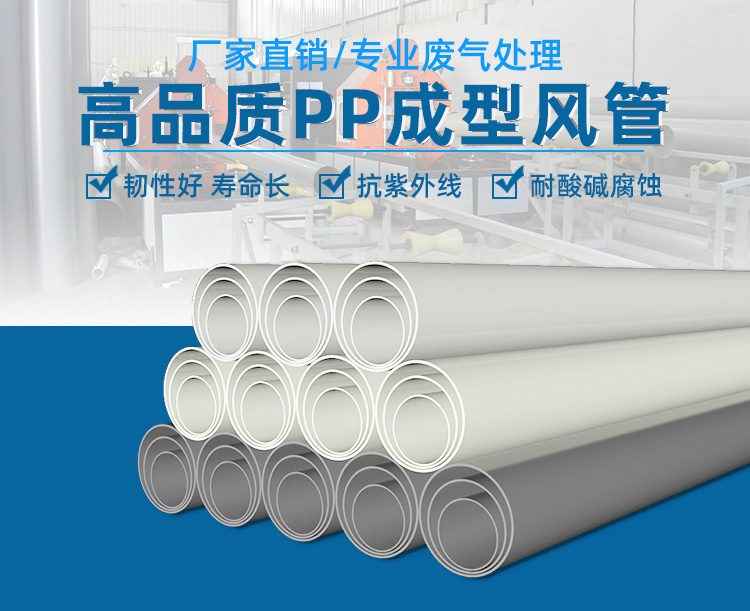
PP Formed Ductwork
| Product Model | PP-F Series (Multiple Specifications) |
|---|---|
| Category | PP Molded Products |
| Reference Price | Price on request |
Product Overview
PP Formed Ducting is a commonly used material for ventilation pipes in exhaust gas treatment equipment, primarily used to collect polluted exhaust gas and transport it through ducts to exhaust gas treatment devices to reduce harmful gas concentrations. Xicheng Environmental Protection offers direct factory sales of PP ducting, including flame-retardant ducts, ventilation pipes, plastic pipes, and formed pipes. With a wide variety of products, full specifications, and large-scale production, procurement is worry-free and efficient. The product is extruded as a single piece using PP/PPs flame-retardant polypropylene material, featuring smooth inner walls, low wind resistance, and corrosion resistance to acids and alkalis. The choice of PP material over traditional galvanized iron or PVC is due to PP's excellent corrosion resistance to inorganic acids, alkalis, and salts. Long-term transportation of acidic or alkaline exhaust gas will not cause rusting or perforation like iron, nor will it release harmful substances like PVC under high temperatures. Additionally, PP is non-toxic, odorless, and recyclable, meeting environmental requirements, making it an ideal choice for exhaust ventilation systems in industries such as chemical, electronics, and coating.
Working Principle
PP Formed Ducting in the exhaust gas treatment system is responsible for exhaust gas collection and transportation. Exhaust gas is collected by hoods or air inlets and transported through PP ducting to exhaust gas treatment devices such as spray towers and activated carbon adsorption towers for purification. The purified gas is then discharged through the ducting by a fan into an exhaust stack. The smooth inner walls of the ducting minimize airflow resistance, effectively reducing fan energy consumption. The PP material is corrosion-resistant and acid/alkali-resistant, making it suitable for transporting corrosive gases and resistant to aging and deformation over long-term use.
Structural Composition
PP Formed Ducting mainly consists of the duct body, flange connection ends, and sealing components. The duct body is produced using a single-extrusion process, ensuring uniform wall thickness and smooth inner walls, which minimize airflow resistance and noise. Compared to traditional manually welded ducts, the seamless, single-extrusion ducts eliminate weld protrusions, preventing eddy currents and dust accumulation. Connection methods include slip-fit or flange connections. Slip-fit connections are suitable for small and medium pipe diameters due to their ease of installation, while flange connections provide secure and reliable connections with excellent sealing performance for larger diameters. Supporting fittings include elbows, tees, reducers, and dampers, which can be assembled into a complete ventilation pipeline system. All fittings are made of the same material as the duct, with the same coefficient of thermal expansion, ensuring no loosening or leakage due to temperature changes after connection. The product is available in both circular and square cross-sectional forms, allowing selection based on site space and airflow requirements. Large-diameter ducts can be processed using sheet welding.
Comparison Between Formed and Processed Ducting
PP Ducting is available in two types: formed and processed. Formed ducting is produced using an extrusion process, offering uniform wall thickness, smooth inner walls, low wind resistance, and high production efficiency, making it suitable for standard specifications and bulk use. Processed ducting is welded from PP flame-retardant sheets and reinforced with flanges, suitable for large diameters, non-standard sizes, and special shapes. Both types share the same material, providing corrosion and acid/alkali resistance, and can be selected based on pipe diameter and site requirements. Standard specifications and small-to-medium diameter branch and sub-ducts are preferably formed ducting, offering high production efficiency, low cost, and smooth inner walls with low wind resistance. Processed ducting is more flexible but slightly more expensive, suitable for large diameters, non-standard sizes, or special shapes where site space is limited. Circular ducts have low wind resistance and save materials, making them ideal for long-distance transportation. Square ducts are suitable for ceiling or wall-mounted installations in space-constrained areas, allowing flexible selection based on site conditions.
Specification Model Table
| Configuration Item | Available Range | Description |
|---|---|---|
| Main Material | PP/PPs Flame-Retardant | Corrosion-resistant to acids and alkalis |
| Forming Method | Single-Extrusion | Uniform wall thickness |
| Duct Shape | Circular/Square | Choose based on site space |
| Connection Method | Slip-Fit/Flange | Choose based on pipe diameter |
| Flame-Retardant Rating | Standard PP/V0 Grade PPs | Choose based on safety requirements |
| Specification Range | Various Specifications | Customizable |
| Supporting Fittings | Elbows/Tees/Reducers/Dampers | Complete set supply |
The above are standard configuration items. Multiple specifications are in stock, and special dimensions are supported for customization. Specific specifications are designed and confirmed by technical personnel based on site conditions, airflow requirements, and space constraints.
Product Features
- Uses PP/PPs flame-retardant polypropylene, acid/alkali-resistant, UV-resistant, and flame-retardant
- Single-extrusion forming, uniform wall thickness, smooth inner walls, low wind resistance
- Wide variety of products and full specifications, circular and square options available, convenient procurement
- Slip-fit or flange connections, easy installation, and excellent sealing performance
- Supporting fittings include elbows, tees, reducers, and dampers, complete set supply
- Non-toxic, hygienic, and recyclable, environmentally friendly, long service life
| 主体材质 | PP/PPs 阻燃聚丙烯 |
|---|---|
| 成型方式 | 挤出一体成型 |
| 管材形状 | 圆形/方形 |
| 连接方式 | 承插/法兰连接 |
| 阻燃等级 | 普通 PP/V0 级 PPs 阻燃 |
| 主要用途 | 废气通风管道 |
| 适用介质 | 腐蚀性气体、酸碱废气 |
| 板材特性 | 防腐、耐酸碱、抗 UV、阻燃 |
| 规格范围 | 多种规格 |
| 配套管件 | 弯头、三通、变径、风阀 |
| 安装方式 | 室内外均可 |
| 固定方式 | 支架固定 |
| 环保特性 | 无毒、可回收利用 |
Application Industries
- Corrosive gas conveying pipelines in chemical and pharmaceutical industries
- Clean air ventilation pipelines in electronics and semiconductor industries
- Waste gas collection and conveying pipelines in painting and coating industries
- Ink solvent waste gas pipelines in printing and packaging industries
- Ventilation and exhaust pipelines in food processing industries
- Exhaust pipelines for fume hoods in laboratories and testing institutions
- Anti-acid and corrosion-resistant ventilation pipelines in environmental pollution projects
Typical Process Locations
In typical waste gas treatment processes, PP formed ducts are used to connect gas transportation between various equipment. After waste gas is collected by hoods or air inlets, it is transported through PP formed ducts to PP spray towers or activated carbon adsorption towers for purification treatment. The purified gas is then discharged into exhaust stacks via PP ducts and PP fans. The duct system requires matching PP elbows, tees, reducers, and dampers, with the pipeline layout designed based on site space and air volume requirements. Xicheng Environmental can provide complete products and solution design services for ducts, fittings, fans, and waste gas treatment equipment. When designing the duct system, it is essential to reasonably control the air velocity. The main duct velocity should generally be kept within the economic flow range. Excessive velocity increases resistance and noise, while insufficient velocity leads to larger duct diameters and higher costs. The pipeline layout should minimize elbows and reducers to reduce local resistance. Additionally, inspection and testing ports should be reserved for convenient daily maintenance and air volume balancing adjustments.
Related Products
View More Hot
Hot
PVC Flexible Duct Connector
 Hot
Hot
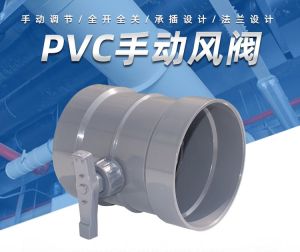
PVC Plastic Damper
 Hot
Hot
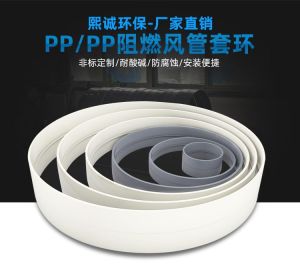
PP plastic ring
 Hot
Hot
PP Manual Damper
Get Quote
PP Manual Damper / PP-F Series (Multiple Specifications)