
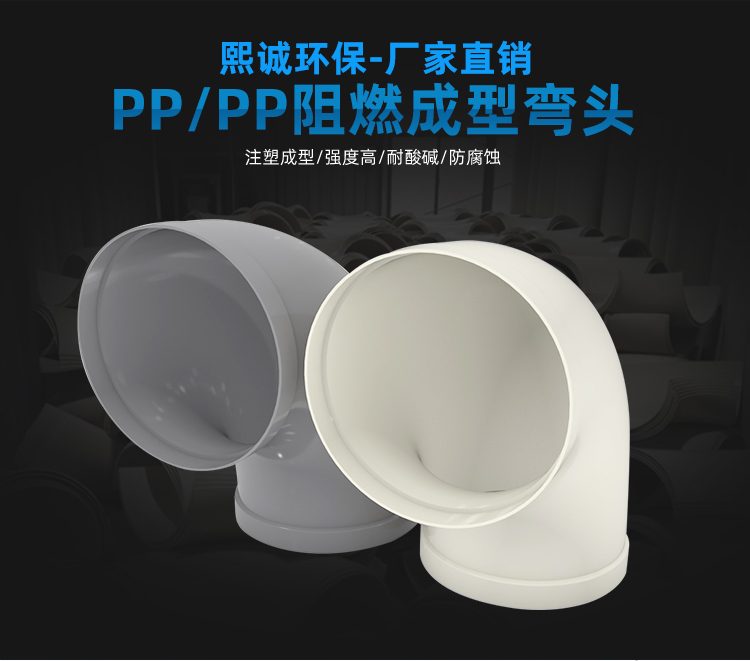
PP Formed Elbow
| Product Model | PP-E Series (Multiple Specifications) |
|---|---|
| Category | PP Molded Products |
| Reference Price | Price on request |
Product Overview
PP elbows are one of the important fittings in PP pipeline engineering, connecting with pipe material through spigot-and-socket joints. They are primarily available in 90-degree and 45-degree angles due to their simple and flexible installation, making them widely adopted. Xicheng Environmental Protection offers direct factory sales of PP flame-retardant elbows, PPs elbows, flame-retardant air duct elbows, plastic elbows, flame-retardant 90-degree elbows, and flame-retardant 45-degree elbows. With a wide variety of products, full specifications, and large-scale production, procurement is both convenient and efficient. The products are made of PP/PPs flame-retardant polypropylene material, offering corrosion resistance and acid/alkali resistance. They match the same material as PP air ducts, with identical thermal expansion coefficients, ensuring no loosening or leakage due to temperature changes after connection. These elbows are indispensable turning joints in ventilation duct systems. Since the elbow and air duct materials are identical, welding and maintenance are facilitated. On-site modifications of angles or extensions of pipe sections can be directly welded using PP welding rods without the need for additional transition joints.
Working Principle
PP formed elbows are used in ventilation duct systems to change airflow direction, allowing pipelines to bypass obstacles or follow designed routes. The inner surface of the elbows is smooth, ensuring smooth airflow transitions and low air resistance. The one-piece molding process guarantees uniform curvature, eliminating eddies and local resistance caused by weld seams. Compared to traditional manually welded elbows, airflow passes more smoothly with lower noise. The spigot-and-socket connection method offers easy installation—simply insert the elbow's socket into the end of the air duct—ensuring a secure seal with sealant or gaskets, eliminating the need for bolt fastening and improving construction efficiency. 90-degree elbows are used for right-angle turns, while 45-degree elbows are used for diagonal turns, selectable based on pipeline layout requirements. As the elbows and PP air ducts share the same material and thermal expansion coefficient, the connection is reliable and less prone to loosening or leakage due to temperature changes over long-term use.
Structural Composition
PP formed elbows primarily consist of a bent pipe body and a spigot-and-socket connection end. The bent pipe body is manufactured using a one-piece molding process, ensuring uniform curvature and a smooth inner surface. This process avoids stress concentration at the elbows' bends, reducing the risk of cracking during long-term use. The spigot-and-socket connection end is precisely matched to the outer diameter of PP air ducts, providing a large contact area for reliable sealing. For larger diameter pipes, a flange connection method can be used, secured with bolts and sealed with gaskets to withstand higher internal pressures. The product angles are mainly 90 degrees and 45 degrees, with specifications compatible with PP air ducts, covering standard small diameters to large diameters. Other angles, such as 30-degree or 60-degree elbows, as well as custom-shaped elbows, can also be provided to meet complex pipeline layout requirements. When selecting, 90-degree elbows are used for right-angle turns in space-constrained areas, while 45-degree elbows are preferred for lower air resistance in areas where pipe space allows, reducing pressure loss. Large-radius curvature elbows are recommended at critical locations like fan inlets and outlets to minimize airflow impact. Large diameter pipes can adopt flange connections for secure and sealed joints.
Elbow Angles and Applications
PP elbows are primarily available in two standard angles: 90 degrees and 45 degrees. 90-degree elbows are used for right-angle turns and are the most common type, suitable for vertical and horizontal pipe redirection. 45-degree elbows are used for diagonal turns, offering lower airflow resistance and are ideal for applications with high air pressure loss requirements. In addition to standard angles, custom angles such as 30-degree or 60-degree elbows, as well as custom-shaped elbows, can be provided to meet complex pipeline layout needs. When selecting, use 90-degree elbows for right-angle turns in space-constrained areas, prioritize 45-degree elbows for lower resistance where pipe space allows, and use large-radius curvature elbows at critical locations like fan inlets and outlets to reduce airflow impact. Large diameter pipes can adopt flange connections to ensure secure and sealed joints.
Specification Model Table
| Configuration Item | Available Range | Description |
|---|---|---|
| Body Material | PP/PPs Flame-Retardant | Corrosion-resistant, acid/alkali-resistant |
| Standard Angle | 90 Degrees / 45 Degrees | Custom angles available |
| Connection Method | Spigot-and-Socket / Flange | Choose based on pipe diameter |
| Molding Method | One-Piece Molding | Uniform curvature |
| Specification Range | Various Specifications | Compatible with air ducts |
| Flame-Retardant Rating | Standard PP / V0 Grade PPs | Choose based on safety requirements |
| Compatible Fittings | Trips / Reducers / Air Valves / Air Ducts | Complete sets available |
The above configuration items can be customized based on on-site conditions, pipe diameter requirements, and pipeline layouts. Specific specifications are designed and confirmed by technical personnel.
Product Features
- Made of PP/PPs flame-retardant polypropylene, acid/alkali-resistant, UV-resistant, and flame-retardant
- One-piece molding, uniform curvature, smooth inner surface for low air resistance
- Primarily 90-degree and 45-degree angles, with custom angles available
- Spigot-and-socket connection for simple and flexible installation, excellent sealing performance
- Wide variety of products and specifications, compatible with PP air ducts
- Same material as air ducts, consistent thermal expansion for reliable connection
| 主体材质 | PP/PPs 阻燃聚丙烯 |
|---|---|
| 标准角度 | 90 度/45 度为主 |
| 连接方式 | 承插连接/法兰连接 |
| 成型方式 | 一体成型 |
| 主要用途 | 通风管道转向连接 |
| 适用介质 | 腐蚀性气体、酸碱废气 |
| 阻燃等级 | 普通 PP/V0 级 PPs 阻燃 |
| 板材特性 | 防腐、耐酸碱、抗 UV、阻燃 |
| 规格范围 | 多种规格 |
| 配套管件 | 三通、变径、风阀、风管 |
| 安装方式 | 承插连接 |
| 定制服务 | 支持非标角度和尺寸定制 |
Application Industries
- Ventilation duct turning connections in chemical and pharmaceutical industries
- Clean pipe turning in electronic and semiconductor industries
- Exhaust gas collection pipe turning in painting and coating industries
- Exhaust gas transport pipe turning in printing and packaging industries
- Ventilation and exhaust pipe turning in food processing industries
- Exhaust air turning in ventilation hoods for laboratories and testing institutions
- Pipe turning in overall ventilation systems of industrial workshops
Typical Process Locations
PP formed elbows are used in ventilation duct systems to change airflow direction and are indispensable pipe components in piping layout. In typical exhaust gas treatment processes, exhaust gas collected by hoods is transported through PP ducts. At turning points, PP formed elbows are used for connection, allowing the pipeline to bypass equipment, beams, columns, and other obstructions and follow the designed route to PP spray towers or activated carbon adsorption towers for purification treatment. Elbow specifications match the corresponding ducts and are used with the same material as the ducts. 90-degree elbows are used for right-angle turns, while 45-degree elbows are used for oblique turns to reduce air resistance. Xicheng Environmental can provide a full range of pipe components (elbows, tees, reducers, dampers, ducts) and complete exhaust gas treatment equipment. In piping design, the number of elbows should be minimized, especially 90-degree elbows, as each additional elbow increases local pressure loss. At critical locations such as fan inlets and outlets, it is recommended to use 45-degree elbows or elbows with large radius of curvature to reduce airflow impact and noise. Sealing should be ensured at elbow connection points to prevent exhaust gas leakage, which may affect workshop environment and purification efficiency.
Related Products
View More Hot
Hot
PVC Flexible Duct Connector
 Hot
Hot
PVC Plastic Damper
 Hot
Hot
PP plastic ring
 Hot
Hot
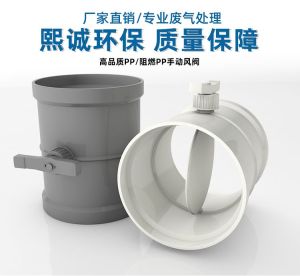
PP Manual Damper
Get Quote
PP Manual Damper / PP-E Series (Multiple Specifications)