
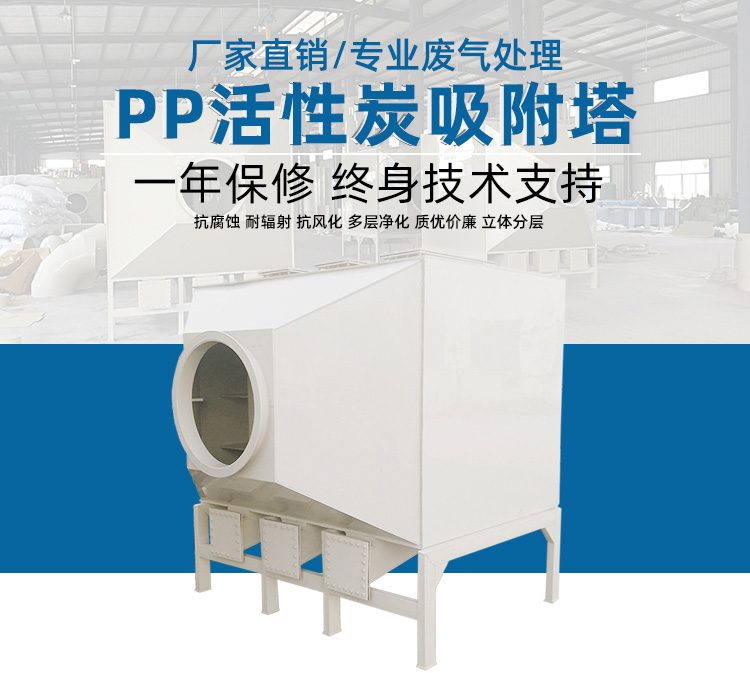
PP Activated Carbon Adsorption Tower
| Product Model | PP-H Series (Customizable) |
|---|---|
| Category | Waste Gas Treatment Equipment |
| Reference Price | Price on request |
Product Overview
The PP Activated Carbon Adsorption Tower, also known as an Activated Carbon Adsorption Box or Activated Carbon Purification Tower, is a purification device for treating organic waste gases and odors. Dusty gases are driven by a fan to enter the tower under positive or negative pressure. Due to the unbalanced and unsaturated molecular or chemical forces on the solid surface of activated carbon, when the solid surface contacts the gas, it attracts gas molecules, concentrating and retaining them on the solid surface, thereby adsorbing pollutants. The filtered exhaust gas enters the equipment's dust removal system and is discharged into the sky for purification. When dust and particulate matter are abundant, the activated carbon adsorption unit can be used simultaneously with a water spray tower to achieve exhaust gas purification and compliance with emission standards.
Working Principle
The activated carbon adsorption equipment primarily utilizes the adsorption effect of porous solid adsorbent activated carbon to effectively remove organic pollutants and color/odor from industrial exhaust gases. Dusty gases are driven by a fan to enter the tower under positive or negative pressure. When the surface of the activated carbon adsorbent contacts the gas, it attracts gas molecules, separating pollutants from the exhaust gas mixture on the surface of the activated carbon, and discharging the purified gas into the sky. Activated carbon adsorption is a physical process; after saturation, the activated carbon must be replaced or regenerated to ensure continuous and stable purification effects.
Structural Composition
The equipment mainly consists of a housing, an inlet, an outlet, an activated carbon adsorption layer, drawer-type trays, a maintenance door, and a filter layer. The drawer-type structure facilitates easy replacement and maintenance of the activated carbon without disassembling the entire equipment. The activated carbon adsorption layer is designed with 2 to 4 layers based on the treatment airflow and pollutant concentration. For high concentrations and large airflow, additional layers are added to extend the adsorption cycle; for low concentrations and small airflow, the number of layers can be reduced to lower costs. Activated carbon can be selected as cylindrical, honeycomb, or granular, with cylindrical carbon offering general applicability, honeycomb carbon providing low resistance, and granular carbon offering a larger specific surface area. Selection is based on exhaust gas composition and system air pressure. The filter layer is used for pre-treating dust and particulate matter in the exhaust gas to protect the activated carbon adsorption layer. The equipment is welded using PP/PPs flame-retardant materials, offering corrosion resistance, acid/alkali resistance, and a robust structure. It can be designed as either vertical or horizontal based on site space.
Adsorption Method Comparison
The activated carbon adsorption tower mainly has two structural types: drawer-type and fixed-type. The drawer-type activated carbon adsorption box adopts a drawer-type tray design, making activated carbon loading and replacement convenient, suitable for medium-low airflow and frequent activated carbon replacement scenarios. The fixed-type activated carbon tower has a large amount of activated carbon loading, suitable for high airflow and continuous operation scenarios, requiring the opening of a maintenance door for activated carbon replacement. Based on exhaust gas composition and concentration, cylindrical, honeycomb, or granular activated carbon can be selected, with the adsorption layer designed as multi-layered to improve adsorption efficiency and extend replacement cycles.
Specification Model Table
| Configuration Item | Available Range | Description |
|---|---|---|
| Main Material | PP/PPs Flame-Retardant | Corrosion-Resistant, Acid/Alkali-Resistant |
| Structural Form | Vertical/Horizontal | Selected Based on Site Space |
| Adsorption Method | Drawer-Type/Fixed-Type | Selected Based on Replacement Frequency |
| Adsorbent Type | Cylindrical/Honeycomb/Granular | Selected Based on Exhaust Gas Composition |
| Adsorption Layers | 2-4 Layers | Designed Based on Concentration and Airflow |
| Processing Airflow | Designed Based on Conditions | Supports Non-Standard Customization |
| Flame-Retardant Rating | Standard PP/V0 Grade PPs | Selected Based on Safety Requirements |
All configuration items can be customized based on customer site conditions, processing airflow, and exhaust gas composition. Specific solutions are designed and confirmed by technical personnel.
Product Features
- Uses PP/PPs flame-retardant materials, acid/alkali-resistant, UV-resistant, flame-retardant, long service life
- Utilizes porous activated carbon adsorption to effectively remove organic pollutants and odors
- Drawer-type structure design, convenient activated carbon replacement, simple maintenance
- Customizable adsorption layers, high purification efficiency, stable operation
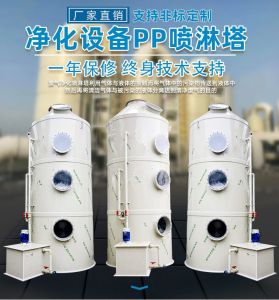
- Can be paired with a spray tower for pre-treatment to protect the activated carbon layer from clogging
- Available in vertical or horizontal designs, supports non-standard dimensions and airflow customization
| 主体材质 | PP/PPs 阻燃聚丙烯 |
|---|---|
| 吸附方式 | 抽屉式/固定式 |
| 吸附剂类型 | 活性炭 |
| 处理对象 | VOC 有机废气、臭味、有机污染物 |
| 工作方式 | 正压或负压吸入式 |
| 阻燃等级 | 普通 PP/V0 级 PPs 阻燃 |
| 活性炭更换方式 | 抽屉式抽取/检修门更换 |
| 预处理方式 | 可配套喷淋塔除尘降温 |
| 塔型 | 立式/卧式 |
| 安装方式 | 室内外均可 |
| 板材特性 | 防腐、耐酸碱、抗 UV、阻燃 |
| 定制服务 | 支持非标尺寸和风量定制 |
Application Industries
- Organic gas and odor purification in chemical and pharmaceutical industries
- VOC organic gas treatment in electronic and semiconductor industries
- Organic gas and paint mist post-purification in coating and spray painting industries
- Ink solvent gas treatment in printing and packaging industries
- Flue gas and organic gas treatment in rubber and plastic industries
- Oil smoke and odor gas purification in food processing industries
- Deep treatment of fume hoods in laboratories and testing institutions
Typical Process Locations
The typical organic gas treatment process involves collecting gas through hoods or ducts, followed by pre-treatment for dedusting and cooling in PP spray towers or swirl towers. The gas then enters a PP activated carbon adsorption tower for deep adsorption and purification, removing VOC organic pollutants and odors. Finally, it is discharged through a PP corrosion-resistant fan via an exhaust stack, meeting emission standards. For scenarios with high dust content, pre-treatment equipment must be installed before the activated carbon tower to prevent particulate matter from blocking the activated carbon pores. Xicheng Environmental can provide complete equipment and solution design services, including activated carbon adsorption towers, spray towers, PP fans, and PP flame-retardant ducts. The design of the activated carbon adsorption tower requires determining the thickness of the adsorption layer and the amount of activated carbon loading based on gas concentration, treatment airflow, and emission standards. If the concentration is too high, additional pre-treatment or multi-stage adsorption processes should be implemented. The replacement cycle of activated carbon should be formulated based on actual operating data. It is recommended to install detection ports at the inlet and outlet of the equipment to regularly monitor purification efficiency, ensuring stable and compliant gas emission.
Related Products
View More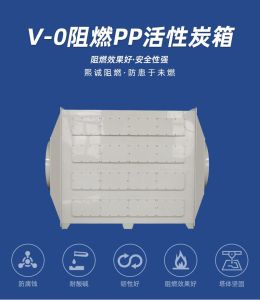 Hot
Hot
V0 PPs Fire Retardant Activated Carbon Box
 Hot
Hot
SDG Dry Acid Mist Adsorption Box
 Hot
Hot
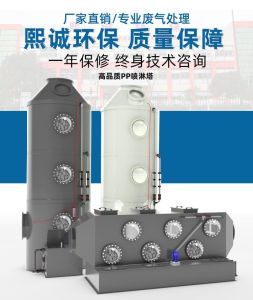
Flame Retardant Horizontal Spray Tower
 Hot
Hot
PP Scrubber
Get Quote
PP Scrubber / PP-H Series (Customizable)