
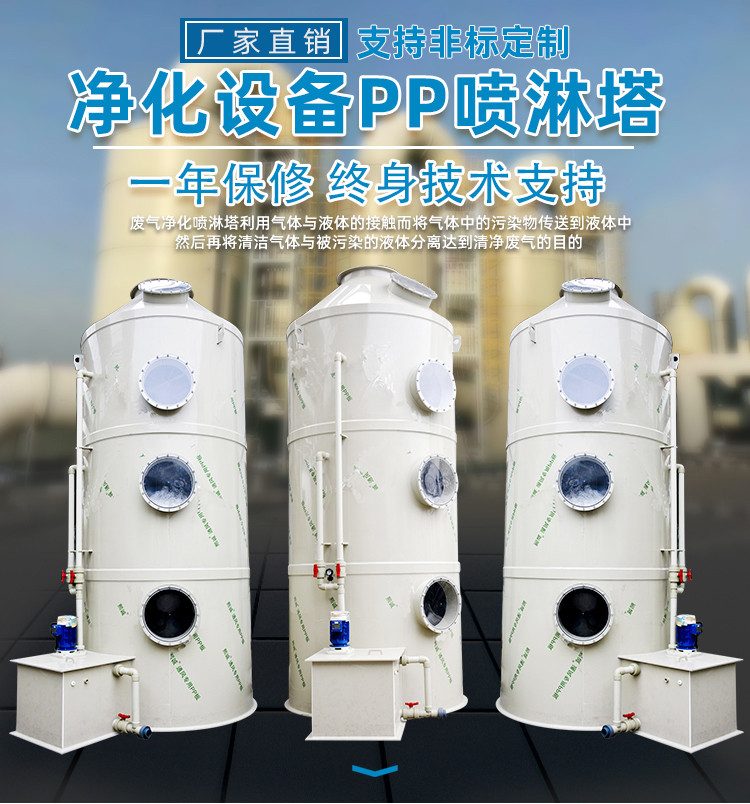
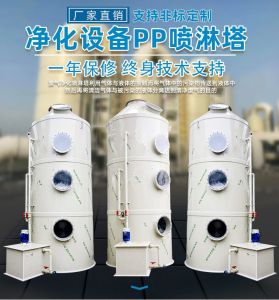
PP Fire Retardant Spray Tower
| Product Model | PP-T Series (φ800–φ3000) |
|---|---|
| Category | Waste Gas Treatment Equipment |
| Reference Price | Price on request |
Product Overview
The PP Flame-Retardant Spray Tower, also known as the PP Washing Tower or Acid Mist Purification Tower, is a wet scrubbing device designed for pre-treatment of industrial acid and alkali exhaust gases, acid mist, and organic exhaust gases. The exhaust gas is introduced into the tower through ductwork, where it comes into full contact with the packing layer and spray absorption liquid for absorption and neutralization. Pollutants are captured by the liquid phase, and the gas is dehumidified by the demisting section before being discharged into the atmosphere by the fan. The absorption liquid is pumped from the bottom of the tower for circulation and spray, ensuring the purified gas meets emission standards. The equipment is fabricated from corrosion-resistant, acid/alkali-resistant, and UV-resistant PP flame-retardant materials, featuring a rational structure, aesthetically pleasing appearance, and robust durability. It can be customized to match the absorption liquid and tower type based on the composition of the exhaust gas and on-site conditions, making it a widely used wet scrubbing device in industrial exhaust gas treatment.
Working Principle
The tower primarily consists of a spray system and a packing system. As the exhaust gas passes through the packing section, it comes into full contact with the flowing washing liquid on the packing surface, neutralizing acidic or alkaline contaminants in the gas. Subsequently, the clean gas is separated from the contaminated liquid. The purified gas is dehumidified and demisted by the demisting plates before being discharged by the fan. The absorption liquid falls to the bottom of the tower, is pumped for pressure enhancement, and is sprayed downward from the top of the tower for recirculation and reuse. For sticky exhaust gases like paint mist or conditions with high dust content, a swirl tower can be selected, utilizing the inertia collision of dust particles with liquid droplets, centrifugal separation, and liquid film adhesion to remove dust.
Structural Components
The equipment, from bottom to top, mainly consists of the inlet duct, storage tank, circulation pump, packing section, grating plate, spray section, inspection window, demisting section, reducer, and outlet duct. The packing section uses PP multi-faceted hollow spheres or Raschig rings as packing materials to increase gas-liquid contact area. The spray section employs multi-layer nozzles for uniform and Dead ends -free spraying. The demisting section is used for dehumidification and demisting, reducing liquid carryover to protect the downstream fan. The inspection window is made of transparent flame-retardant material for easy observation and maintenance. Standard equipment includes spray pipes, ball valves, flow meters, differential pressure gauges, integrated grating, tank covers, water replenishment and drainage kits, and high-flow pumps. All components are designed in standardized modular form for easy on-site installation and maintenance. The storage tank is integrated with the tower body to minimize leakage risks.
Tower Type Classification
Based on structure, the towers are classified into four types: vertical spray towers, horizontal towers, swirl towers, and spiral towers. Vertical cylindrical towers have a small footprint and low cost, making them the preferred choice for conventional applications. Horizontal square towers have a relatively complex manufacturing process and higher cost but lower height, suitable for installations with height constraints. Swirl towers use multi-layer swirl vanes for bidirectional spraying in both forward and reverse directions, ideal for sticky exhaust gases like paint mist and dusty conditions. Spiral towers are formed through integral winding, offering high mechanical strength, excellent overall integrity, corrosion resistance, and anti-leakage properties. Wall thickness can be customized between eight to seventy millimeters, making them suitable for applications requiring high strength and durability.
Specification and Model Table
| Specification/Model | Tank Body (mm) | Bottom Plate (mm) | Spray Section | Packing Section Height (mm) | Demisting Section | Demisting Section Height (mm) | Inspection Window Size | Outlet Duct |
|---|---|---|---|---|---|---|---|---|
| φ800 | 8 | 8 | 2/1 | 400 | 1 | 600 | φ400 | φ315 |
| φ1000 | 8 | 10 | 2/1 | 400 | 1 | 600 | φ400 | φ355 |
| φ1200 | 8 | 10 | 2/1 | 400 | 1 | 600 | φ400 | φ400 |
| φ1500 | 8 | 10 | 2/1 | 500 | 1 | 600 | φ500 | φ500 |
| φ1800 | 10 | 10 | 2/1 | 500 | 1 | 600 | φ500 | φ600 |
| φ2000 | 10 | 12 | 2/1 | 500 | 1 | 600 | φ500 | φ650 |
| φ2200 | 10 | 12 | 2/1 | 500 | 1 | 600 | φ500 | φ700 |
| φ2500 | 12 | 12 | 2/1 | 500 | 1 | 600 | φ500 | φ800 |
| φ2800 | 12 | 15 | 2/1 | 500 | 1 | 600 | φ500 | φ900 |
| φ3000 | 12 | 15 | 2/1 | 500 | 1 | 600 | φ500 | φ1000 |
Standard equipment includes spray pipes, ball valves, flow meters, differential pressure gauges, integrated grating, tank covers, new-type water replenishment and drainage kits, and high-flow pumps; overall dimensions and structure can be customized based on customer site conditions and treatment airflow requirements.
Product Features
- Uses PP/PPs flame-retardant materials, resistant to acid/alkali, UV, and flame-retardant, with long service life
- Specialized packing combined with multi-layer spraying for full gas-liquid contact and effective absorption/neutralization
- Specialized demisting section reduces liquid carryover at the outlet, effectively protecting downstream fans
- Recirculation of absorption liquid reduces water and chemical consumption, lowering operating costs
- Comprehensive standard specifications available, with non-standard customization possible based on site conditions
- Can be supplied as a complete set with activated carbon adsorption boxes, PP fans, ductwork, and dampers
| 主体材质 | PP/PPs 阻燃聚丙烯 |
|---|---|
| 塔型分类 | 立式 / 卧式 / 旋流 / 缠绕 |
| 板材特性 | 防腐、耐酸碱、抗 UV、阻燃 |
| 标准规格范围 | φ800–φ3000 |
| 桶身壁厚 | 8–12mm |
| 底板厚度 | 8–15mm |
| 缠绕塔壁厚定制范围 | 8–70mm |
| 喷淋层形式 | 2/1 多层喷淋 |
| 视窗规格 | φ315/φ400/φ500 |
| 出风口规格 | φ315–φ1000 |
| 填料类型 | PP 多面空心球 / 拉西环 |
| 处理对象 | 酸碱废气、酸雾、有机废气 |
| 安装方式 | 室内外均可 |
Application Industries
- Absorption and purification of acidic and alkaline exhaust gases such as sulfuric acid mist, hydrochloric acid mist, and alkali mist in chemical and pharmaceutical production processes
- Control of acid mist and chromic acid mist generated in acid washing lines and electroplating tanks in electroplating and surface treatment industries
- Acidic and alkaline exhaust air washing and purification in laboratories and etching processes in the electronics and semiconductor industries
- Pre-treatment of paint mist and dust in the coating and spray painting industry (recommended to use cyclone tower structure)
- Pre-cooling, dedusting, and demisting before activated carbon and catalytic combustion equipment in organic exhaust gas treatment
- Centralized purification of acidic and alkaline exhaust gases in fume hoods and exhaust systems of laboratories and testing institutions
- Exhaust gas treatment in production processes of industries such as metallurgy, textiles, rubber, plastics, automotive, and cement
Typical Process Locations
The typical exhaust gas treatment process involves collecting exhaust gas through hoods or ducts, which first enters a PP flame-retardant spray tower for acidic and alkaline washing, cooling, and dedusting, and then enters deep treatment equipment such as activated carbon adsorption boxes based on pollutant composition. Subsequently, it is discharged through a PP corrosion-resistant fan via an exhaust stack to meet emission standards. For high-concentration or insoluble exhaust gases, multi-stage spray Series or a combination with other purification equipment can be adopted. The equipment can be installed vertically or horizontally based on on-site space and flexibly connected with upstream and downstream equipment through PP flame-retardant ducts. Xicheng Environmental Protection can provide complete sets of equipment such as spray towers, activated carbon adsorption boxes, PP fans, PP flame-retardant ducts, and dampers, as well as one-stop services including solution design, equipment manufacturing, and installation and commissioning.
Related Products
View More Hot
Hot
V0 PPs Fire Retardant Activated Carbon Box
 Hot
Hot
SDG Dry Acid Mist Adsorption Box
 Hot
Hot
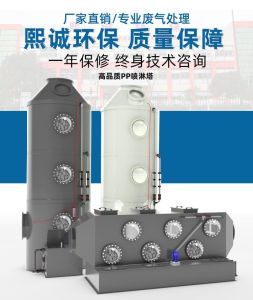
Flame Retardant Horizontal Spray Tower
 Hot
Hot
PP Scrubber
Get Quote
PP Scrubber / PP-T Series (φ800–φ3000)