
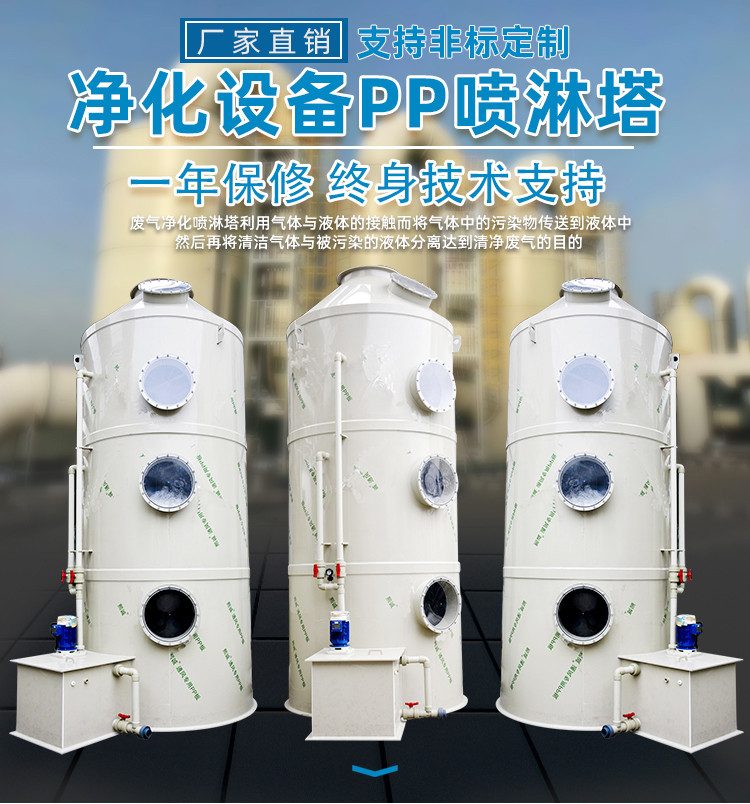
PP Scrubber
| Product Model | Packing Spray Scrubber Exhaust Gas Absorption Tower |
|---|---|
| Category | Waste Gas Treatment Equipment |
| Reference Price | Price on request |
Product Overview
The PP waste gas scrubber is a general-purpose packed tower for liquid absorption treatment of water-soluble waste gases. The tower body is entirely welded with PP or PPs plate, offering excellent corrosion resistance. Waste gas is introduced into the scrubber via ductwork, where it comes into full contact with the absorption liquid through the packing layer, neutralizing pollutants. The purified gas then passes through demisting plates for moisture and mist removal before being exhausted into the atmosphere via a fan. This mature and reliable process is suitable for a wide range of applications and serves as a fundamental equipment for acid-base and water-soluble waste gas treatment in industries such as chemical, electroplating, electronics, and pharmaceuticals.
Compared to specialized towers focused on acid mists, the PP waste gas scrubber is a more versatile platform product. By replacing the absorption liquid formulation and adjusting the packing and spraying configuration, it can handle various water-soluble gases such as hydrogen chloride, hydrogen fluoride, ammonia, sulfuric acid mist, chromic acid mist, hydrogen cyanide, sodium hydroxide vapor, hydrogen sulfide, and some formaldehyde. Acidic gases are absorbed by alkaline solutions, while alkaline gases are treated with acidic solutions. Some organic soluble gases are absorbed by water or specialized absorption liquids. The tower features high standardization and a full range of specifications, available for single-stage or multi-stage series treatment of high-concentration or complex-component gases.
The PP waste gas scrubber supplied by Xicheng Environmental Protection includes the tower body, packing, spraying system, demisting plates, circulating water pump, and dosing system. The tower diameter is series-matched to the treatment airflow, while the tower height and packing layers are designed based on pollutant concentration and purification requirements. It can be equipped with pH automatic dosing and liquid level protection, and supports PPs flame-retardant material for indoor installation, making it the most widely applicable wet scrubber for waste gas purification.
Working Principle
The core process of the PP waste gas scrubber is packed tower liquid absorption. Waste gas is introduced at the bottom of the tower and rises through the packing layer under fan suction. Absorption liquid is pumped to the top of the tower via a spray pipe, where it is uniformly sprayed onto the packing, forming a continuous liquid film that flows downward along the packing surface. The gas-liquid two phases flow countercurrently and make full contact in the packing layer. Pollutants in the gas phase enter the liquid phase through dissolution, absorption, and chemical reactions, purifying the waste gas. The packing provides a large and continuously renewed gas-liquid contact surface, which is key to mass transfer and absorption.
The purified gas continues to rise and passes through demisting plates where the airflow changes direction multiple times. Liquid droplets carried by the gas are captured by the demisting plates under inertial collision and flow down the plate surface to return to the water tank. The gas, now dehumidified and demisted, is exhausted into the atmosphere via the fan through an exhaust stack. The absorption liquid circulates in the water tank at the bottom of the tower, where its effective components gradually deplete and salts accumulate. The dosing system replenishes the absorption agent, while wastewater exchange maintains absorption capacity. The discharged effluent enters the wastewater treatment system. The entire process operates continuously, ensuring stable purification efficiency as long as the absorption liquid concentration, spraying amount, and gas-liquid contact conditions are maintained. The PP material is not corroded by acid-base gases, and the tower body and packing remain rust-free and undamaged even after long-term immersion.
Structural Composition
The PP waste gas scrubber consists of the tower body, inlet section, packing support, packing layer, spraying system, demisting plates, circulation water tank, circulation pump, and dosing device. The tower body is a cylindrical tube welded from PP plate rolls, with reinforcing rings on the outer wall. The bottom of the tower serves as the circulation water tank, with an inlet at the bottom and an outlet at the top or side.
The packing layer is supported by grating plates and filled with PP multi-faceted spheres or Raschig rings. A single or multiple spray pipes with solid conical or spiral nozzles are installed above each packing layer to ensure full cross-sectional coverage. Multi-stage towers have multiple packing layers and spray systems. A demisting baffle is installed above the packing layer. The water tank is equipped with a water replenishment port, overflow port, effluent port, dosing port, level gauge, and manhole. The circulation pump inlets and outlets are fitted with valves and filters. The dosing device consists of a drug storage tank, metering pump, and pH meter. External features include a ladder, maintenance platform, observation port, inspection door, and flanges for inlet and outlet ducts.
Specification Model Table
The table below shows typical treatment targets and absorption liquid selection for the PP waste gas scrubber, configured based on gas composition.
| Gas Category | Representative Pollutant | Absorption Liquid |
|---|---|---|
| Acidic Gas | Hydrogen Chloride, Hydrogen Fluoride, Sulfuric Acid Mist | Alkaline Solution |
| Alkaline Gas | Ammonia | Acidic Solution / Water |
| Other Water-Soluble Gas | Hydrogen Sulfide, Some Formaldehyde | Water / Specialized Absorption Liquid |
Product Features
The PP waste gas scrubber features a mature process, wide treatment range, and stable operation, making it the most versatile wet scrubber. Key features include:
- Mature liquid absorption process ensures stable and reliable purification effect
- Countercurrent gas-liquid contact in packing layer achieves high mass transfer efficiency
- Multiple water-soluble gases can be treated by simply replacing the absorption liquid
- PP or PPs tower body and packing resist acid-base corrosion with long service life
- Demisting plates remove moisture and mist, minimizing liquid carryover in fan exhaust
- Circulating liquid reuse reduces water and chemical consumption, enhancing operational economy
- Standardized specifications allow multi-stage Series and automatic dosing
| Tank Material | PP / PPs Sheet |
|---|---|
| Purification Process | Liquid Absorption Method |
| Core Components | Filler layer with spray nozzle |
| Gas-Liquid Flow Direction | Counter-current contact |
| Dehydration Components | Defogging Plate |
| Absorption fluid | Select according to exhaust gas |
| Circulation Mode | Tank Bottom Water Circuit |
| Corrosion resistance performance | Acid-alkali-resistant salt |
| Configuration Form | Single-stage / Multi-stage Cascade |
| Specifications and Features | By airflow series |
Application Industries
- Acid-alkali and water-soluble tail gas absorption and treatment in chemical workshops
- Centralized exhaust gas washing in electroplating and surface treatment parks
- Acid-alkali exhaust air purification in semiconductor, photovoltaic, and electronic factories
- Water-soluble component absorption of reaction tail gas in pharmaceutical factories
- Acid mist control in pickling and battery industries
- Odor gas washing of hydrogen sulfide, ammonia, etc. in wastewater treatment stations
- Comprehensive exhaust air centralized wet purification in laboratories
Typical Process Locations
The PP exhaust gas purification tower is installed between the polluting workshop and the fan. The exhaust gas is transported from the hood and duct to the lower inlet of the tower. Inside the tower, the exhaust gas rises from bottom to top through the packing layer, spray layer, and demisting layer, and is purified before entering the corrosion-resistant fan at the top or side outlet for compliant discharge through the exhaust stack. The circulating water pump, chemical addition tank, and control cabinet are arranged near the tower body, and the water tank effluent is connected to the wastewater treatment station. When treating multiple incompatible exhaust gases, they should be processed in separate systems and towers, such as acidic and alkaline exhaust gases, and cyanide-containing exhaust gases cannot be mixed in the same tower or duct to avoid hazardous reactions.
During installation, the tower body is vertically fixed on the foundation, with the weight of the equipment and liquid being supported by the foundation. Flexible connections and independent brackets are installed on the duct. The startup sequence is to first start the circulating water pump to fully wet the packing and ensure normal spraying, then start the fan to draw air; the shutdown sequence is the opposite. Key operational management focuses on maintaining the absorption liquid concentration and level, normal spray pressure, unobstructed packing, and effective demister. Regularly test the inlet and outlet concentrations and circulating liquid indicators, and maintain records of chemical addition, effluent discharge, and maintenance.
Related Products
View More Hot
Hot
V0 PPs Fire Retardant Activated Carbon Box
 Hot
Hot
SDG Dry Acid Mist Adsorption Box
 Hot
Hot
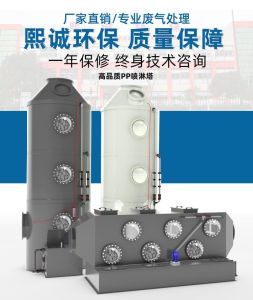
Flame Retardant Horizontal Spray Tower
 Hot
Hot
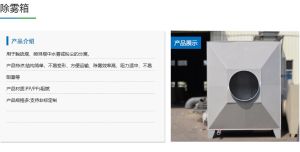
PP Defogging Box
Get Quote
PP Defogging Box / Packing Spray Scrubber Exhaust Gas Absorption Tower