
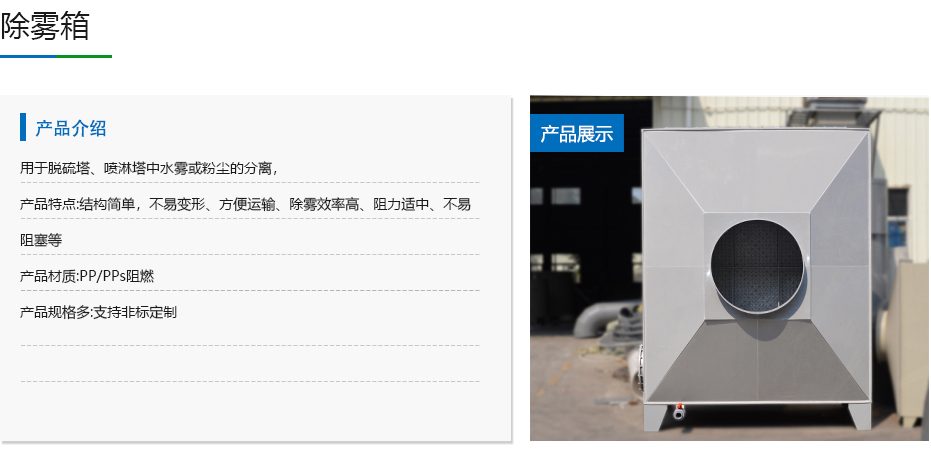
PP Defogging Box
| Product Model | PP Gas-Liquid Separation Demister |
|---|---|
| Category | Waste Gas Treatment Equipment |
| Reference Price | Price on request |
Product Overview
The PP demister, also known as a gas-liquid separator or dehumidifier, is a gas-liquid separation device installed at the outlet of a spray washing tower or in a mist-containing gas pipeline, used to remove water mist and liquid droplets carried by exhaust gas. Gases purified by spray towers often carry a large number of fine liquid droplets. If directly entering fans and exhaust chimneys, they will corrode fan impellers and ducts, cause "rain" and white smoke in exhaust chimneys, and carry away absorption agents. The PP demister separates liquid droplets from the airflow through internal water collection plates or packing materials and recycles them, protecting downstream equipment. It is an important auxiliary device for wet exhaust gas treatment systems.
There are two main demisting methods in the demister: one is the water collection plate (baffle plate, water barrier) type, where the airflow changes direction multiple times in a tortuous channel, and due to inertia, liquid droplets collide with the plate surface, accumulate into larger droplets, and flow down along the plate surface for separation. The other is the packing type, where packing materials are stacked inside the box to form complex channels. Liquid droplets collide and coalesce on the packing surface and are trapped. Both methods feature simple structures, high demisting efficiency, low pressure drop, low risk of blockage, small footprint, and low operating costs. They can be selected based on the mist content of the gas and demisting requirements, or used in combination to improve dehydration effectiveness.
Xicheng Environmental can design PP demisters according to the treatment airflow and mist droplet characteristics. The box body is welded from PP or PPs plate materials and is acid and alkali-resistant. It is equipped with baffle water collection plates or packing layers, a flushing device, and a water collection and drainage structure. It can be used as an independent demister in series after the tower, or the demisting section can be integrated at the top of the spray tower to meet the gas carryover requirements of fans and exhaust chimneys.
Working Principle
The baffle plate type demister utilizes the principles of inertial collision and gravitational sedimentation. Air carrying liquid droplets enters the baffle channel and is forced to make multiple sharp turns. Since the mass and inertia of liquid droplets are much greater than those of the gas, they cannot turn synchronously with the airflow and collide with and adhere to the wall of the baffle plates. Liquid droplets accumulate into films on the plates and continue to merge and grow. When gravity exceeds the buoyant force of the airflow and the surface tension, they flow down along the plates into the bottom water collection area for discharge, while the gas continues to flow out along the channel, achieving gas-liquid separation. The spacing, deflection angles, and flow velocity of the baffle plates determine the minimum particle size of captured liquid droplets and the pressure drop.
The packing type demister utilizes the principle of collision and coalescence on packing surfaces. As the airflow passes through the packing layer, it repeatedly changes direction and contacts the wet packing surfaces. Fine liquid droplets collide, adhere, and coalesce into larger droplets on the packing. Under the action of gravity, they fall into the water collection area. The complex channels and large specific surface area of the packing layer provide strong collection ability for fine mist droplets, but the pressure drop is slightly higher than that of baffle plates and blockage must be prevented. The separated liquid is collected at the bottom of the box and is either recirculated to the tower's water tank via a liquid seal or drainage pipe for collection and treatment, preventing gas short-circuiting through the drainage pipe. The PP material has a smooth surface, hydrophobic properties, and corrosion resistance, making it easy for liquid droplets to coalesce and slide off. The plate surface is not prone to scaling, and it remains corrosion-resistant in acidic and alkaline mist environments for long-term stable demisting performance.
Structural Components
The PP demister consists of a box body, demisting internals (baffle plates or packing), support structure, flushing device, water collection and drainage section, and inlets and outlets. The box body is a rectangular or cylindrical shell welded from PP or PPs plate materials, with reinforced outer walls. Flanges are installed at both ends for connection to ducts or towers.inspection door and manhole are provided on the box body for maintenance.
The baffle plate type internals consist of multiple parallel baffle plates (PP plates or profiles) installed at certain intervals on a frame to form tortuous airflow channels. The packing type internals stack PP packing materials or mesh demisters on a grille. Flush water pipes and nozzles can be installed above or to the side of the demisting internals to regularly clean dust and crystallization from the plates and packing. The lower part of the box body is the water collection area, equipped with a drainage pipe, liquid seal (U-tube or water seal), and a drain outlet. The separated liquid is recirculated via the liquid seal to prevent gas bypass. Inlets and outlets are set according to the airflow direction, and an airflow distribution plate may be installed if necessary.
Specification and Model Table
The following table compares the characteristics of the two demisting methods for selection based on mist content.
| Demisting Method | Characteristics | Applicable |
|---|---|---|
| Baffle Plate Type | Low resistance, easy to flush | Larger droplets, high dust content |
| Packing Coalescing Type | Strong fine mist collection capability | Fine mist droplets |
| Combined Type | Two-stage dehydration | High demisting requirements |
Product Features
The PP demister offers high dehydration efficiency, low pressure drop, and easy maintenance, serving as a protective device for fans in wet exhaust gas systems. Its main features are as follows.
- Effectively removes liquid droplets carried by airflow, high demisting efficiency
- Two methods: baffle plates and packing, adaptable to different mist conditions
- Smooth airflow channels, low pressure loss, economical operation
- Smooth plate surface, low risk of blockage, allows online flushing
- Compact structure, small footprint, easy installation in series
- PP or PPs box body, acid and alkali-resistant, long service life
- Separated liquid recirculated via liquid seal, no gas short-circuiting
| Box material | PP / PPs sheets |
|---|---|
| Defogging Method | Water Receiver / Packing |
| Separation Principle | Inertial Collision Agglomeration and Settling |
| Separation Objects | Water Mist Droplets |
| Resistance Characteristics | Low resistance |
| Washing Configuration | Settable rinsing device |
| Drainage Method | Water Accumulation Liquid Sealing Return System Our Water Accumulation Liquid Sealing Return System is designed to efficiently manage and |
| Corrosion resistance performance | Acid-alkali-resistant salt |
| Anti-clogging performance | Not easily clogged |
| Specifications and Features | Customized according to airflow |
Application Industries
- Gas-liquid separation and dehydration for spray tower and scrubber outlet
- Anti-fogging protection for fans in acid-alkali exhaust gas treatment systems
- Elimination of white smoke and "rain" phenomenon before exhaust stacks
- Gas-liquid separation of dust-containing liquid droplets at the outlet of wet dust removal equipment
- Dehumidification before activated carbon adsorption after absorption towers
- Condensate recovery and water removal from cooling towers and scrubbing equipment
- Gas-liquid separation for liquid-containing gas pipelines and equipment
Typical Process Locations
The most typical location for PP demisters is between the spray tower outlet and the fan inlet, with airflow paths being spray tower, demister, corrosion-resistant fan, and exhaust stack. When the demister plates inside the tower are insufficiently effective or the tower suffers severe liquid carryover, an independent demister is installed externally for secondary dehydration. When followed by water-sensitive processes like activated carbon adsorption, the demister serves as a necessary pre-treatment protective device. Demisters can also be directly installed at the bottom of exhaust stacks or horizontal pipe sections, with installation orientation ensuring that separated liquid can self-drain to the collection area. The installation direction of baffle plates and packing must align with airflow indicators.
During installation, the demister body is positioned horizontally or as required, with the bottom drainage pipe connected to a liquid seal (water seal height must exceed fan negative pressure) to ensure liquid discharge without gas bypass. Independent supports are provided for inlet and outlet air pipes. Before operation, inspect baffle plate spacing, packing installation, and rinse water pipes. During operation, monitor water carryover in exhaust stacks and liquid accumulation on fans. Regularly activate rinse water to clean dust and crystallization on baffle plates and packing, and check if the liquid seal maintains water level and if the drain valve is unobstructed. If demister resistance abnormally increases, it is often due to internal component blockage or rinse failure, requiring immediate cleaning.
The baffle channel of the water collection plate features open design, low resistance, and is less prone to blockage, making it easy to clean. It is suitable for applications with larger liquid droplets, dusty or crystalline gas, and low resistance requirements, being the most common form. The packed (or mesh) channel has a dense structure and a large specific surface area, demonstrating strong collection capability for fine mist droplets and high mist removal efficiency. However, it has slightly higher resistance and is prone to blockage by fine debris, making it suitable for scenarios with fine droplets, low dust content, and high mist removal requirements. For high-demand applications, a two-stage combination of baffle plates and packing can be adopted, first removing large liquid droplets and then capturing fine mist, balancing anti-blocking and efficiency.
Related Products
View More Hot
Hot
V0 PPs Fire Retardant Activated Carbon Box
 Hot
Hot
SDG Dry Acid Mist Adsorption Box
 Hot
Hot
Flame Retardant Horizontal Spray Tower
 Hot
Hot
PP Scrubber
Get Quote
PP Scrubber / PP Gas-Liquid Separation Demister