
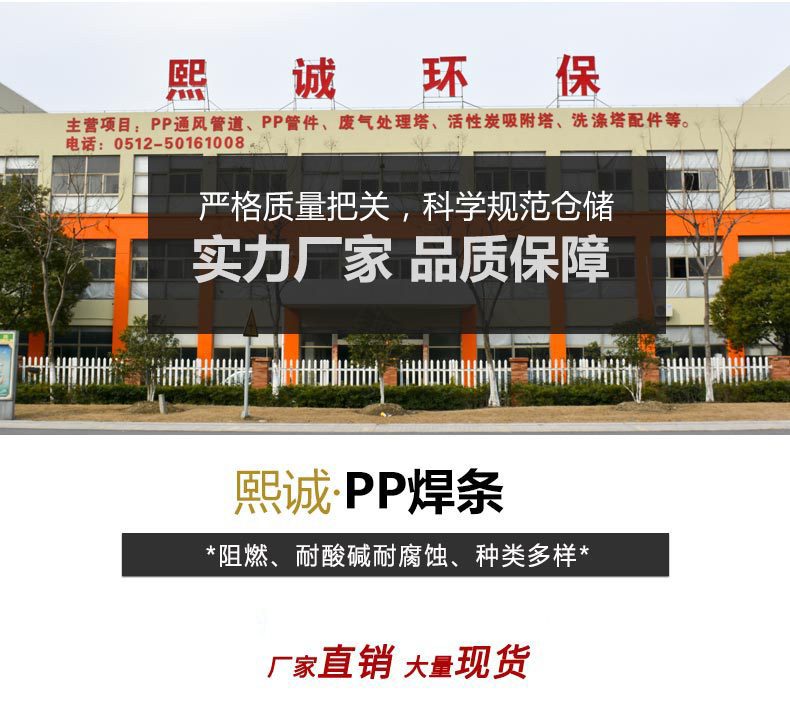
PP Flame-Retardant Welding Rod
| Product Model | Circle Welding Rod / Triangle Welding Rod / Double Wire Welding Rod |
|---|---|
| Category | PP-PPs Sheets |
| Reference Price | Price on request |
Product Overview
The PP Flame-Retardant Welding Rod is a plastic welding consumable extruded and drawn from flame-retardant polypropylene, specifically designed for the hot melt connection between PP flame-retardant sheets and PP tubing. The welding rod material matches the base material, and after melting and solidifying, the weld fuses seamlessly with the base material, maintaining corrosion resistance to acids and alkalis and flame-retardant self-extinguishing properties at the joint.
The welding rods are categorized by cross-sectional shape, including round, triangular, and double-strand types. Round welding rods are suitable for root welding and small gap joints, triangular welding rods provide a large contact area with V-grooves, making them ideal for fill welding and structural joints, while double-strand welding rods offer high deposition rates, enhancing welding efficiency for thick plates. Different cross-sectional types can be combined to meet a wide range of welding requirements, from thin-plate ducts to thick-walled tanks.
The PP Flame-Retardant Welding Rods supplied by Xicheng Environmental are available in colors matching the paired PP sheets, with white and beige options in stock. Specifications cover common processing ranges. The rods are supplied in coils or bundles, neatly wound with moderate hardness, ensuring smooth wire feed during welding. After melting, they exhibit excellent fluidity, minimal shrinkage upon cooling, and well-formed, full welds.
Working Principle
The welding principle of the PP Flame-Retardant Welding Rod is hot melt welding. During installation, the hot air from the hot air welding gun simultaneously heats the rod and the joint between the sheets, reaching the melting temperature of polypropylene. The rod is fed into the joint under slight pressure, allowing molten plastic molecules to diffuse and entangle, forming a continuous, solid weld upon cooling. Since the rod and base material are the same polymer, there are no issues with intermaterial bonding at the weld interface.
The corrosion and flame-retardant properties of the weld originate from the rod's material. The flame-retardant welding rod contains flame-retardant components, forming a uniform flame-retardant system with the PP sheets. When exposed to fire, the weld does not become a weak point. The rod's corrosion resistance operates similarly to the sheets, as polypropylene molecules do not react with common corrosive media, ensuring long-term stability in corrosive gas and liquid environments.
Structural Composition
Round welding rods have a solid circular cross-section, with diameter specifications forming a series. Fine rods are used for thin plates and precision areas, while coarse rods are suitable for thick plate filling. Triangular welding rods have an isosceles triangular cross-section, with the triangular base fitting the root of the groove during welding, allowing for the filling of large joint gaps in a single pass, reducing the number of welding layers.
Double-strand welding rods consist of two parallel round bars, forming an 8-shaped cross-section. They have approximately twice the deposition rate per unit length compared to single-round rods of the same diameter, making them ideal for rapid filling of thick plates. The rod surfaces are smooth and evenly sized, with reasonable bending radii during coiling, preventing dead folds and cracks. The appropriate cross-section should be selected based on the specifications of the welding gun's wire feed nozzle.
Specification Model Table
The table below lists the common cross-sectional types and applications of PP Flame-Retardant Welding Rods. Specific diameters can be selected based on welding processes.
| Welding Rod Type | Cross-Sectional Shape | Primary Application |
|---|---|---|
| Small Round Rod | Round | Thin plate root welding, small gap joints |
| Large Round Rod | Round | Thick plate filling, multi-layer welding |
| Triangular Rod | Triangular | V-groove filling |
| Double-Strand Rod | Double Round Parallel | Thick plate rapid filling |
Product Features
The PP Flame-Retardant Welding Rod is a critical consumable for ensuring the welding quality of PP equipment, with the following key features.
- Matches the PP base material, ensuring consistent corrosion and flame-retardant performance in welds
- Comprehensive cross-sectional types, suitable for welding from thin to thick plates
- Excellent fluidity upon melting, resulting in full weld filling with minimal voids
- Colors match the sheets, ensuring coordinated and uniform weld appearance
- Coiled supply, smooth wire feed, ideal for continuous welding operations
- Corrosion resistance to acids, alkalis, and salts, with welds remaining stable even after prolonged immersion
- Flame-retardant and self-extinguishing, avoiding weak points in equipment fire safety
| Material | Flame Retardant Polypropylene (PPs) |
|---|---|
| welding electrode type | %= "Round Welding Electrode / Triangular Welding Electrode / Double-Strand Welding Electrode" % |
| Color | Porcelain White / Beige |
| Molding Process | Extrusion Drawing Our extrusion drawing services provide precision shaping and sizing of materials to meet your exact specifications. With |
| Welding method | Hot air hot melt welding |
| Flame Retardant Properties | Self-extinguishing |
| Corrosion resistance performance | Acid-alkali-resistant salt |
| Supply Form | Coiled / Bundled |
| Complementary Base Material | PPs Flame Retardant Plate and Pipe |
| Applicable plate thickness | Both thin plates and thick plates are applicable |
| Welding Temperature | By material process settings |
Application Industries
- Welding of lap joints in the cylindrical shells of spray towers and scrubbing towers
- On-site welding of longitudinal and circumferential seams in PPs ventilation ducts
- Sheet assembly for activated carbon adsorption boxes and anti-corrosion tanks
- Leak repair welding for electroplating acid pickling tanks and PP water tanks
- Welding of the shell and internal partitions of laboratory fume hoods
- Seam repair during maintenance of chemical anti-corrosion equipment
- Connection filling for non-standard PPs irregular parts fabrication
Typical Process Locations
PP flame-retardant welding electrodes are used in every splicing process during equipment manufacturing alongside PPs sheets. After cutting and rolling the sheets, the longitudinal seams are filled with electrodes as a base layer. The circumferential seams of tube splices, corner seams between flanges and cylinders, and connections of internal reinforcement ribs all require electrode deposition. The quality of the electrodes directly determines the tightness and structural strength of the welds.
During on-site installation, splicing between prefabricated tubes, interfaces between equipment and ventilation ducts, and secondary openings due to design changes all require on-site welding with electrodes. At this stage, electrodes are used in conjunction with portable hot air welding guns. Construction environments are often at heights or in confined spaces, and the smoothness of electrode wire feeding and deposition efficiency will affect the progress and quality of on-site installation. Before use, electrodes are selected according to the parent material type and color—ceramic white or beige workpieces are paired with matching colored electrodes. Electrodes must be kept dry and clean; damp or contaminated electrodes should be dried before reuse. During welding, electrode specifications and torch temperatures are selected based on plate thickness. Electrodes and torches are fed synchronously at a uniform speed to ensure full fusion of the molten pool. Remaining electrodes are stored in sealed containers to prevent moisture, with different materials and batches of electrodes managed separately. After welding, seams are inspected and accepted according to the parent material's appearance and strength requirements.
Related Products
View More Hot
Hot
PPs Flame Retardant Boards
 Hot
Hot
PPs Beige Flame Retardant Sheet Material
 Hot
Hot
PP Plastic Hot Melt Gun
Get Quote
PP Plastic Hot Melt Gun / Circle Welding Rod / Triangle Welding Rod / Double Wire Welding Rod