
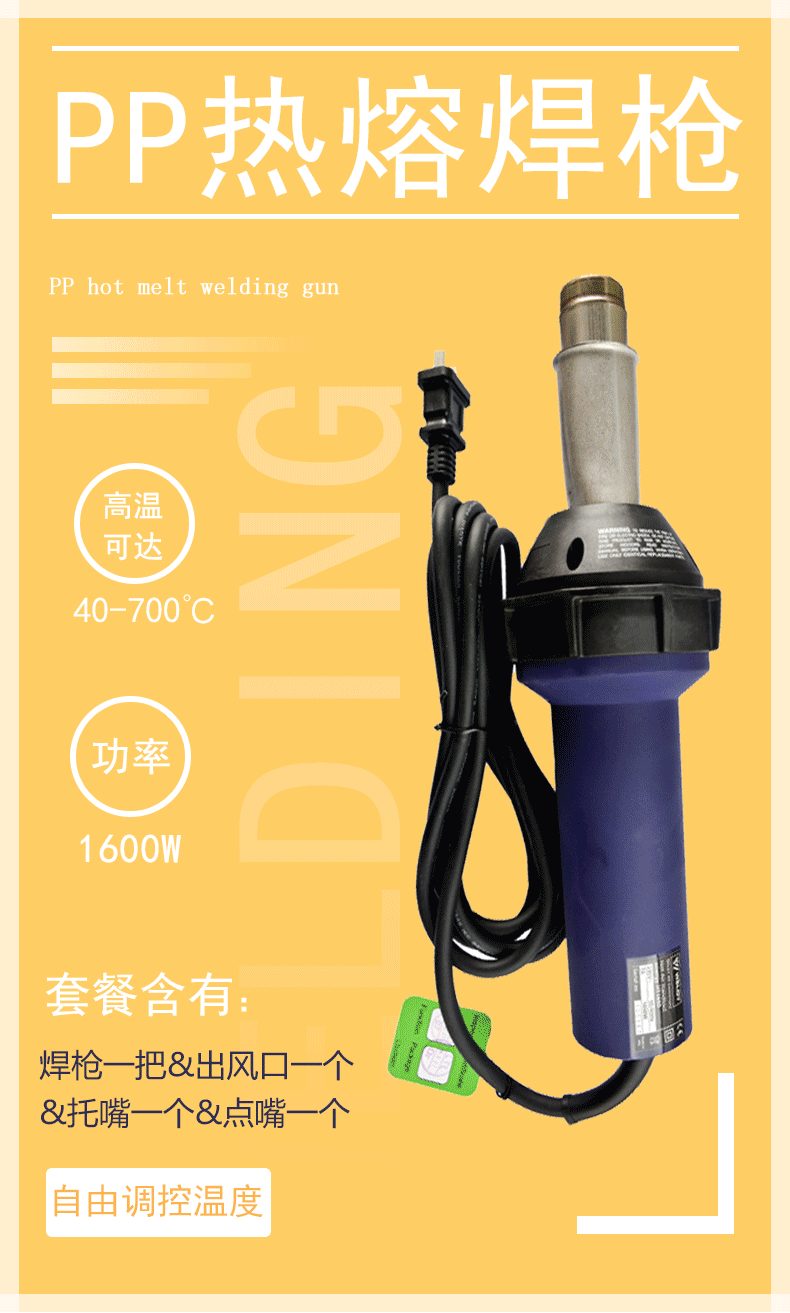
PP Plastic Hot Melt Gun
| Product Model | Temperature-regulating hot air plastic welding gun |
|---|---|
| Category | PP-PPs Sheets |
| Reference Price | Price on request |
Product Overview
The PP Plastic Hot Melt Welder is a handheld plastic welding tool that uses hot air as its heat source, primarily designed for the hot melt splicing of PP and PPs sheet materials and pipes. The heating core inside the welder heats the air drawn in by the fan and expels it through the nozzle. The high-temperature hot air simultaneously heats the welding rod and the joint, melting the plastic to achieve pressure bonding, which solidifies into a strong weld after cooling.
The welder body features an insulating structure design, and the handle conforms to handheld operation habits, reducing fatigue during prolonged use. The device temperature can be adjusted based on the sheet thickness and ambient temperature. Combined with various nozzles such as flat, round, triangular, and quick-pull welding nozzles, it can perform multiple tasks including joint splicing, corner welding, underfilling, cap filling, and quick welding. It is a commonly used tool in防腐 equipment workshops for production and on-site installation.
The PP Plastic Hot Melt Welder supplied by Xicheng Environmental Protection is compatible with PP Flame-Retardant Welding Rods and PPs sheet materials, suitable for applications such as the splicing of spray tower cylinders, longitudinal and circumferential welding of ducts, panel assembly of sumps, and on-site joint repairs. The welder offers stable heating, rapid temperature rise, and large airflow, making it suitable for both fixed workstation use in workshops and on-site operations in high-altitude or confined spaces.
Working Principle
After the welder is powered on, the motor drives the impeller to draw ambient air into the gun body. The air flows through the ceramic or metal heating core and is rapidly heated, then expelled from the front nozzle in a directional stream. During welding, the nozzle aligns simultaneously with the welding rod and the joint bevel. The heat melts the surface of the welding rod and the top layer of the sheet material joint. The welder operator moves the welding rod along the joint at a uniform speed while applying slight pressure, filling the joint with molten plastic. After exiting the hot air zone, the molten plastic cools and solidifies to form the weld.
Temperature adjustment is key to ensuring welding quality. PP material must be within the appropriate melting temperature range to achieve full fusion. If the temperature is too low, it may result in incomplete bonding between the welding rod and the base material, leading to joint cracking under stress. Conversely, if the temperature is too high, the material may carbonize, turn yellow, develop pores, or even burn through thin sheets. Adjustable temperature welders change heating power via a knob or electronic thermostat, allowing operators to set the temperature based on sheet thickness, welding rod specifications, and ambient temperature, while controlling heat input through gun movement speed.
Structural Components
The welder primarily consists of the gun body, fan motor, heating core, temperature control components, nozzles, and power cord. The rear of the gun body houses the air intake and fan, the middle section features an insulating handle and heating chamber, and the front is equipped with replaceable nozzles. The temperature control knob or display is located above the handle for easy observation and adjustment. The heating core is often designed for replacement, allowing for individual maintenance once it ages.
Nozzles are available in various forms based on their intended use. Flat nozzles emit wide-angle hot air, suitable for preheating sheet material joints and large-area welding. Round nozzles concentrate heat, working with round welding rods for underfilling and corner welding. Quick-pull welding nozzles feature a rod guide slot, allowing the welding rod to pass through while being heated simultaneously, enabling one-handed operation for wire feeding and welding, ideal for long straight welds.
Specifications and Models Table
The table below lists common specifications and applications of plastic hot air welders, with actual nameplate details为准.
| Type | Application | Welding Thickness |
|---|---|---|
| Small Power Adjustable Temperature Welder | Thin sheets, repairs, on-site repairs | 2–8mm |
| Standard Adjustable Temperature Welder | Duct, tower body routine welding | 5–20mm |
| High-Power Welder | Thick sheets, sump multi-layer welding | 15mm and above |
| Quick-Pull Welding Kit | Continuous operation for long straight welds | As per nozzle compatibility |
Product Features
The PP Plastic Hot Melt Welder is compact and easy to adjust, serving as a fundamental tool for plastic corrosion protection equipment processing. Its main features include:
- Uniform hot air heating ensures synchronous melting of the welding rod and base material, resulting in high-strength welds
- Continuous temperature adjustment, suitable for various sheet thicknesses and construction environments
- Replaceable nozzles for joint splicing, corner welding, and quick-pull welding
- Excellent body insulation, reducing heat transfer during prolonged handheld operation
- Fast heating speed, allowing entry into welding condition shortly after startup
- Compact and lightweight design,便于 high-altitude and on-site narrow space operations
- Replaceable heating core, low maintenance costs, and long service life
| Material Welding | PP / PPs Plastic |
|---|---|
| Heating Method | Hot air heating |
| Temperature Regulation | Adjustable Temperature |
| Welding Nozzle Type | 扁嘴 / 圆嘴 / 快速焊嘴 |
| Power Supply Method | AC Power Supply |
| Cooling Method | `Cooling Fan` |
| Handheld Design The product features a compact and ergonomic handheld design, optimized for ease of | Handheld |
| Companion Welding Electrodes | PP Round Welding Electrode / Triangular Welding Electrode |
| Applicable plate thickness | 2–20mm and above |
| Equipment Form | Handheld hot air welder |
| Applicable Scenarios | On-site welding and workshop welding |
Application Industries
- Shop welding of spray towers and tanks in anticorrosion equipment manufacturing plants
- Longitudinal and circumferential welding of PPs ventilation ducts on installation sites
- Manufacturing and rewelding of electroplating acid washing tanks and chemical water tanks
- Repair welding of pipe joints during maintenance of exhaust gas treatment projects
- Processing and fabrication of laboratory fume hoods and plastic exhaust hoods
- On-site pipe modification and welding for acid-base exhaust systems in semiconductor factories
- Field operations for outdoor and high-altitude work by environmental equipment installation companies
Typical Process Locations
The hot melt welding gun covers the entire process from manufacturing to installation of PPs equipment. In the workshop, the gun works with fixtures to complete the curling of longitudinal seams, circumferential seams of cylindrical bodies, corner seams of flanges, and internal reinforcement structure welding after plate cutting. On the construction site, the gun is used for butt welding between prefabricated pipe sections, connecting equipment inlets/outlets with ventilation ducts, and local sealing near support brackets.
During maintenance and repair, the gun is the primary tool for handling leaks and Renovation openings. When weld leaks occur during equipment operation, the medium is drained, the surface is cleaned, and the gun is used with electrodes for rewelding. When production line adjustments require adding branch pipes or connections, openings are made on-site, and the gun is used to weld short pipes and flanges. The portability of the gun allows these operations to be completed without returning the equipment to the factory. Before use, the hot air temperature is adjusted based on plate thickness and ambient temperature. A test weld is performed on scrap material to confirm good fusion before starting the actual welding. During welding, the gun, electrodes, and weld seams maintain a stable angle and uniform speed. After the job is finished, the gun nozzle is cleaned promptly, cooled, and stored. Power cords and heating cores are inspected regularly. Field operations should be kept away from flammable materials and ensure proper ventilation.
Related Products
View More Hot
Hot
PPs Flame Retardant Boards
 Hot
Hot
PPs Beige Flame Retardant Sheet Material
 Hot
Hot
PP Flame-Retardant Welding Rod
Get Quote
PP Flame-Retardant Welding Rod / Temperature-regulating hot air plastic welding gun