
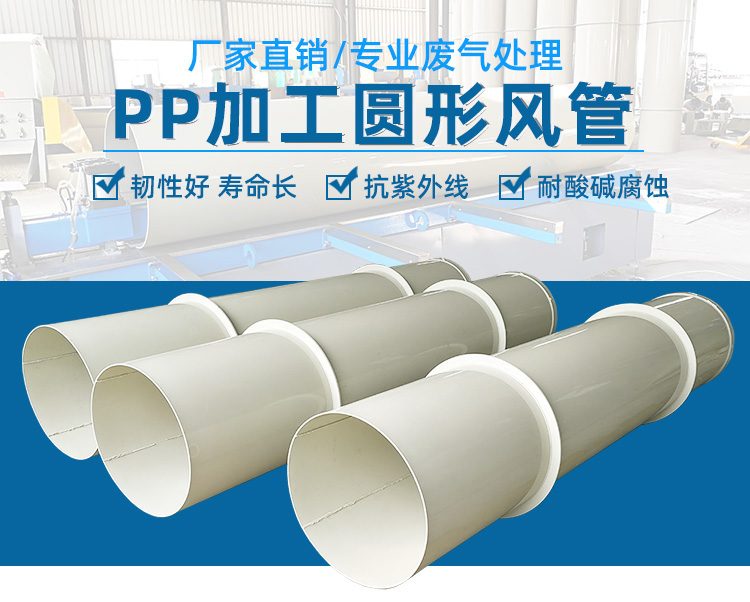
PP Fire-Retardant Process Ductwork
| Product Model | PPs Plate Welded Round Duct Series |
|---|---|
| Category | PP Machined Products |
| Reference Price | Price on request |
Product Overview
Flame-retardant PP welded ductwork is circular ventilation pipes processed from flame-retardant PP sheets through cutting, bending, welding, and flange reinforcement. Compared to extruded ducts, welded ducts are not limited by standard diameters and can be manufactured in large diameters, thick walls, and special lengths, making them suitable for high-capacity exhaust gas transportation main pipes and non-standard corrosion-resistant ventilation projects.
The duct body is formed from PP flame-retardant sheets, with longitudinal seams welded using PP flame-retardant electrodes for hot fusion welding. The seams are dense and have the same service life as the base material. Flanges or sockets are welded at both ends of the pipe segments for connection. PP material has good toughness, acid/alkali/salt corrosion resistance, lightweight properties, and smooth inner walls that prevent dust accumulation. It does not rust or scale when transporting corrosive exhaust gases, and also possesses flame-retardant self-extinguishing properties, making it ideal for indoor and fire-rated applications.
Xicheng Environmental can design and produce flame-retardant PP welded ductwork based on drawings and on-site conditions, along with complete sets of fittings such as elbows, tees, reducers, dampers, and supports. Eco-friendly, non-toxic PP, and recyclable, it has been widely used in corrosion-resistant engineering in chemical, environmental wastewater treatment, and surface finishing industries as a steel alternative.
Working Principle
Welded ducts serve as gas transportation channels in ventilation systems. Exhaust gas flows along the pipes under the pressure differential provided by the fan. The circular cross-section ensures uniform stress distribution and low air resistance, while the smooth inner walls reduce flow resistance compared to metal rusted pipes. The welded pipe segments are connected via flanges or spigots to form a continuous network, collecting exhaust gas from collection points and conveying it to purification equipment, which then treats and discharges the gas through a stack.
The corrosion and flame-retardant properties of the ducts are provided by the PP sheet material itself. Polypropylene does not react with acidic or alkaline exhaust gases, preventing rust and thinning of the pipe wall due to corrosive gas flow. The flame-retardant components ensure the sheet self-extinguishes upon contact with fire, preventing the pipe from becoming a fire spread path when installed indoors or in suspended ceilings. The welds use PP flame-retardant electrodes, ensuring the joints maintain the same corrosion and flame-retardant properties as the entire pipe, avoiding weak points at connection points.
Structural Composition
A single welded duct consists of the body, longitudinal seams, circumferential reinforcement, and end connection components. The body is formed by rolling PP sheets, with longitudinal seams created at the joints. For large-diameter or high-negative-pressure segments, circumferential reinforcement rings are welded to the outer wall to enhance external pressure resistance and prevent collapse due to fan suction. PP flanges are welded at the ends for bolted connection, or sockets are formed for slip-fit welding.
Pipe segments are connected via flanges with gaskets and bolts, or sealed with electrodes after slip-fitting. Elbows, tees, reducers, and other fittings are processed using the same materials and techniques as straight pipes. External supports and hangers are installed based on load requirements, with independent brackets near flanges for large-diameter pipes. The entire duct system, from sheets to electrodes and flanges, uses the same plastic series, ensuring consistent thermal expansion and contraction, and minimizing stress at connections.
Specification Model Table
The table below compares the characteristics of welded ducts and extruded ducts. Specific diameters and wall thicknesses are determined based on airflow design.
| Item | Welded Duct | Extruded Duct |
|---|---|---|
| Diameter | Non-standard large diameter | Standard series |
| Wall Thickness | Can be thickened as needed | Standard wall thickness |
| Connection | Flange / Spigot | Spigot For the main |
| Application | High-capacity main pipes | Standard branch pipes |
Product Features
Flame-retardant PP welded ducts offer flexible diameters and corrosion/flame-retardant properties, making them the preferred choice for high-capacity non-standard corrosion-resistant ventilation projects. Key features include:
- PPs flame-retardant sheet welding, self-extinguishing in case of fire, safe for indoor use
- Corrosion resistance to acids, alkalis, and salts; does not rust when transporting corrosive exhaust gases
- Unrestricted by standard diameters; can be processed in large diameters and thick walls
- Welds and base material share the same material, ensuring equal corrosion service life at joints
- Round cross-section reduces air resistance, smooth inner walls prevent dust accumulation
- Weight is about one-fifth of steel pipes, easing installation and handling
- Complete set of accessories available; supports non-standard customization based on drawings
| Material | PPs Flame Retardant Boards |
|---|---|
| Processing Technology | Hot Welding of Rolled Plates |
| Section Shape | Round |
| Flame Retardancy | Self-extinguishing |
| Corrosion Resistance Performance | Acid and Alkali Salt Resistant |
| Connection Method | Flange / Butt-welding |
| Inner Wall Features | Smooth and dust-free |
| Specifications and Features | Large Diameter Non-Standard Customization |
| Accessories | Bend Tee Convergent Divergent Air Valve |
| Sheet Thickness | Select by caliber |
| Strengthening Method | Outer wall reinforcement ring |
Application Industries
- Main air conveying pipes for large airflow acid-alkali exhaust in chemical enterprises
- Corrosion-resistant exhaust main pipes in electroplating and surface treatment workshops
- Large-diameter flame-retardant exhaust pipes in semiconductor and photovoltaic factories
- Main air conveying pipes for acid pickling line exhaust collection in metallurgical plants
- Large-diameter connecting pipes for fans in environmental treatment projects
- Corrosion-resistant pipes for odor collection and exhaust in wastewater treatment plants
- Fireproof exhaust main pipes in indoor and suspended ceilings
Typical Process Locations
Flame-retardant ducts are primarily used for main pipes and large-diameter sections in exhaust systems. They collect air from various hoods and branch pipes at the front end, run along supports to purification equipment, and are discharged after treatment via fans and exhaust stacks. Large-diameter sections are concentrated at fan inlets/outlets and main passages between equipment, while standard-formed ducts are used for smaller branch pipes, connected via diameter changes and flanges.
In indoor and crowded areas, flame-retardant ducts are installed openly along columns, beams, or dedicated supports, or laid in ceilings and pipe galleries. When pipes pass through fire compartments, fireproof sealing is used. During installation, pipe segments are aligned at flanges with gaskets for sealing, and supports are set based on pipe weight and thermal expansion. Extra bending moments must not be applied near flanges, and thermal expansion compensation must be considered for long straight pipe sections. Before installation, pipe diameters, wall thicknesses, and flame-retardant ratings are verified. Pipe segments are aligned and grouped on supports, with flange gaskets sealed and bolts tightened evenly. Long straight sections are provided with expansion allowances for thermal expansion. When passing through fire compartments or floors, fire dampers and incombustible sealing are used. Outdoor pipe sections require corrosion and rain protection for supports. Regular inspections are conducted during operation to check welds, flanges, and supports. If wind leakage, collapse, or abnormal vibration is detected, the system is shut down for repair to maintain pipe sealing and support stability.
Related Products
View More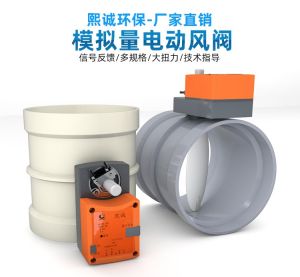 Hot
Hot
PP Fire-Resistant Analog Air Valve
 Hot
Hot
PP Fire-Resistant Closed-Check Valve
 Hot
Hot
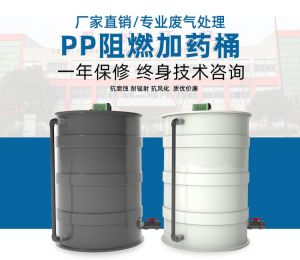
PP Flame Retardant Additive Drum
 Hot
Hot
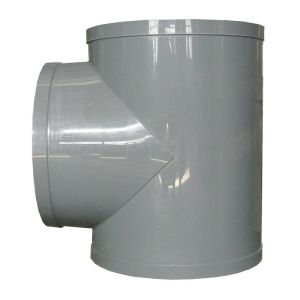
PP Flame Retardant Processed T-Connector
Get Quote
PP Flame Retardant Processed T-Connector / PPs Plate Welded Round Duct Series