
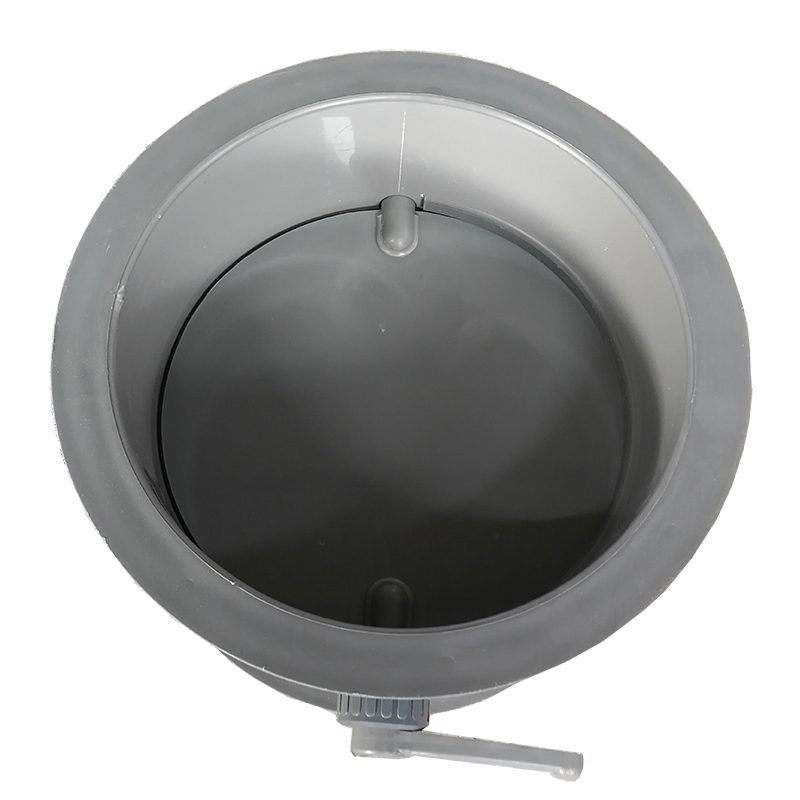
PP Fire-Retardant Process Damper
| Product Model | PPs plate-welded round manual air valve |
|---|---|
| Category | PP Machined Products |
| Reference Price | Price on request |
Product Overview
The PPs flame-retardant processing damper is a circular manual air volume regulating damper made by processing the valve body of PPs flame-retardant sheet material through roll welding. Its structural form is the same as that of a general PP processing damper, with the difference being that the valve body, valve plate, and welding rod are all made of flame-retardant PPs material. This retains the acid and alkali corrosion resistance advantages of polypropylene while also possessing flame-retardant self-extinguishing properties. It is primarily used for large-diameter circular corrosion-resistant air ducts in indoor exposed installations, suspended ceilings, and locations requiring fire inspection approval.
While general PP air duct dampers are corrosion-resistant, the material is flammable, posing a fire spread risk when used indoors or in fire compartments. The PPs flame-retardant plate is enhanced with flame-retardant additives, making the sheet difficult to sustain combustion when exposed to open flames and self-extinguishing after the fire source is removed. The damper, as a component on the pipeline, is matched with flame-retardant air ducts to ensure the flame-retardant continuity of the entire corrosion-resistant ventilation system, meeting the fire requirements of indoor corrosion-resistant exhaust engineering.
The PPs flame-retardant damper processed by Xicheng Environmental Protection has a plate-welded circular structure. The valve plate can be reinforced, and large-diameter models are equipped with worm gear mechanisms. The ends can be connected via flanges or socket connections, with the valve plate edge optionally fitted with a sealing strip. The diameter, wall thickness, and length are not limited by molds and can be produced according to drawings to match PPs flame-retardant processing air ducts, making it suitable for exhaust systems in industries such as chemical processing, electroplating, laboratories, and semiconductor manufacturing that require both corrosion resistance and fire protection.
Working Principle
The air volume regulation principle of the flame-retardant processing damper is the same as that of a general circular damper. Turning the handle or wheel drives the valve plate to rotate within the valve body, changing the flow cross-section and local resistance to achieve air volume regulation and actuation. Large-diameter valves use worm gear reduction for effortless operation with self-locking functionality. The reinforced valve plate structure resists airflow pulsation and prevents noise caused by vibration at small openings.
Flame retardancy is the core feature of this product. The flame-retardant components in the PPs sheet suppress flame propagation during combustion, causing the flame to self-extinguish after the ignition source is removed, preventing the damper and connected air ducts from becoming pathways for fire spread. The valve plate, valve body, welding rod, and sealing components are all matched with flame-retardant or non-flammable materials to prevent any non-flame-retardant parts from creating flame paths. In terms of corrosion resistance, PPs retains the chemical stability of polypropylene against acid, alkali, and salt exhaust gases, ensuring no rust or sticking in long-term use in corrosive environments.
Structural Composition
The flame-retardant processing damper consists of a PPs plate-welded valve body, flame-retardant valve plate, valve shaft, shaft seat, operating mechanism, and flanges. The valve body is formed by rolling PPs sheet and welding, with longitudinal seams welded using PPs flame-retardant electrodes. The valve plate is a PPs circular plate, with large-diameter valve plates welded with reinforcing ribs or constructed as a double-layer structure. The valve shaft passes through the valve body, with both ends fixed to the outside of the valve body and sealed.
The operating mechanism uses a locked handle for small diameters and a worm gear wheel mechanism for large diameters, with the valve plate edge optionally fitted with a corrosion-resistant and flame-retardant soft sealing strip. The valve body ends are welded with PPs flanges or formed into sockets, with flanges drilled according to air duct standards. Corrosion-resistant metal or coated components are used for the valve shaft, pins, and other load-bearing parts. The shaft sleeve is made of self-lubricating corrosion-resistant material to ensure smooth operation in flame-retardant environments. For automated control, the valve body can be equipped with an electric actuator.
Specification Model Table
The following table compares the flame-retardant damper with the general PP damper. Specific diameters are determined based on air duct design.
| Item | PPs Flame-Retardant Damper | General PP Damper |
|---|---|---|
| Flame Retardancy | Self-extinguishing | Not applicable |
| Corrosion Resistance | Acid, alkali, salt resistant | Acid, alkali, salt resistant |
| Applicable Locations | Fire compartments indoors | Outdoor or no requirements |
| Processing Method | Plate-welded non-standard | Plate-welded / Formed |
Product Features
The PPs flame-retardant processing damper integrates corrosion resistance, flame retardancy, and large-diameter customization, making it a specialized regulating valve for indoor corrosion-resistant exhaust trunk pipes. Its main features are as follows.
- PPs flame-retardant sheet roll-welded, self-extinguishing, meets fire requirements
- Corrosion-resistant to acid, alkali, salt, no sticking in corrosive gases
- Full flame-retardant matching for valve body, valve plate, and welding rod, no flame paths
- Large-diameter valve plate reinforced with worm gear, effortless and vibration-free
- Non-standard diameter, wall thickness, and length, compatible with flame-retardant air ducts
- Flange socket connection, optional soft seal, easy installation
- Can be retrofitted with electric actuators for automated control needs
| Body Material | PPs Flame Retardant Board Material |
|---|---|
| Welding Electrode Material | PPsFlame-RetardantWeldingElectrode |
| Processing Technology | Roll Plate Welding Assembly |
| Section Shape | Round |
| Flame Retardancy | Self-extinguishing |
| Corrosion resistance performance | Acid-alkali-resistant |
| Drive Type | Handle / Worm Gear Manual |
| Connection method | Flange / Butt-welding |
| Specifications and Features | Large-diameter custom non-standard |
| Valve Disc Structure | Single-piece reinforced stiffening |
| Sealing Options | Soft Seal Option Available |
Application Industries
- Large-diameter corrosion-resistant exhaust dry pipe valves for chemical plant indoor ventilation
- Round flame-retardant air duct dampers for fire-rated areas in electroplating workshops
- Corrosion-resistant exhaust dry pipe regulating valves for semiconductor and panel factories
- Indoor round duct section dampers for laboratory exhaust systems
- Corrosion-resistant air dampers with fire protection requirements for suspended ceilings and pipe galleries
- Corrosion-resistant exhaust vertical shaft inlet valves for high-rise buildings
- Full system valves compatible with PPs flame-retardant air ducts
Typical Process Locations
Flame-retardant processing dampers are installed on circular PPs flame-retardant air ducts indoors, in suspended ceilings, in pipe galleries, and within fire-rated areas. They are used in conjunction with flame-retardant air ducts and flame-retardant fittings to ensure consistent flame retardancy levels across the pipeline system. On pipelines passing through fire-rated areas, damper locations must be coordinated with fire dampers or fire sealing according to fire protection design. Plastic flame-retardant dampers cannot replace fire protection dampers specifically designed for fire protection. Dry pipe valves are used for regional airflow regulation and maintenance isolation.
Installation methods are the same as those for standard plate-welded round valves. The valve body is coaxial with the air duct, with flange fastening and sealing. A heavy-duty worm gear mechanism is supported by an independent bracket, with the operating handle oriented toward the maintenance access channel. During acceptance, in addition to checking the airflow regulation function, the material flame retardancy certification must be verified to ensure consistency with the air duct system. For indoor dry pipes requiring remote control, an electric actuator can be installed on the same flame-retardant valve body, with proper fire protection for the actuator.
Related Products
View More Hot
Hot
PP Fire-Resistant Analog Air Valve
 Hot
Hot
PP Fire-Resistant Closed-Check Valve
 Hot
Hot
PP Flame Retardant Additive Drum
 Hot
Hot
PP Flame Retardant Processed T-Connector
Get Quote
PP Flame Retardant Processed T-Connector / PPs plate-welded round manual air valve