
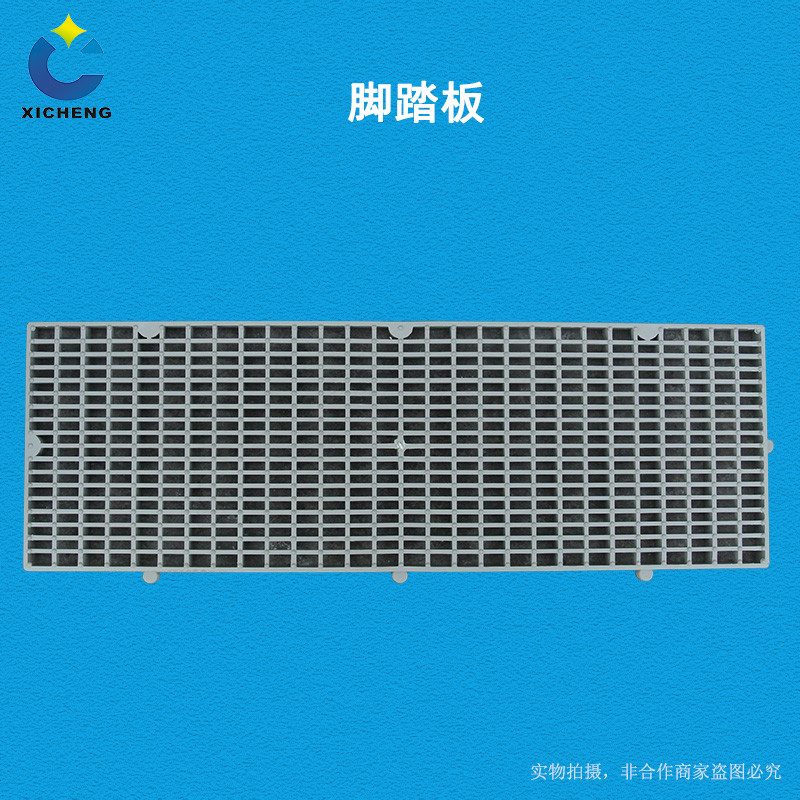
PP Pedal
| Product Model | Injection Molded Anti-Slip Grating Step Plate |
|---|---|
| Category | PP Molded Products |
| Reference Price | Price on request |
Product Overview
The PP walkway plate is a corrosion-resistant and slip-resistant walkway board designed for installation on electroplating production lines, acid washing tank edges, and chemical plant operation areas. Made from PP material through injection molding, the plate is highly resistant to deformation. The surface features anti-slip protrusions to enhance friction, while the open holes allow for rapid drainage of splashed acidic or alkaline liquids, keeping the working surface dry and ensuring operator safety.
Grounds in electroplating and chemical workshops are frequently exposed to acidic, alkaline, and corrosive chemicals. Steel grating is prone to rusting, while conventional flooring can delaminate and deteriorate when exposed to prolonged moisture. PP walkway plates are acid and alkali resistant, water-absorbent, and rust-free. They provide excellent slip resistance even on wet edges and are lightweight, making them easy to transport and install. Each plate can be individually replaced for maintenance, making them a common surface protection accessory in surface treatment workshops.
The PP walkway plates supplied by Xichen Environmental are standard injection-molded plates with edge splicing and fixing structures, allowing for continuous paving along production lines and walkways. They are supported by brackets or beams below, with splashed liquids draining into ground-level drainage channels. These plates can also be used for equipment maintenance platforms, top operating areas of towers, and walkway covers for corrosion-resistant trenches.
Working Principle
The anti-slip mechanism of the walkway plate comes from its anti-slip protrusions and grid texture. The protrusions create multi-point contact between the sole and the plate, disrupting water films on the foot and increasing friction resistance in wet conditions, thereby reducing the risk of slipping on liquid-covered surfaces. The open holes allow for timely drainage of splashed chemicals and rinsing water, preventing liquid accumulation and reducing slipperiness.
The corrosion-resistant principle stems from the chemical stability of PP material. Polypropylene does not react with common acids, alkalis, or salt solutions. When chemicals are splashed onto the plate, they either drain through the holes or remain on the surface, unlike steel which rusts and thins, or wood which absorbs water and decays. The elevated installation allows for ventilation beneath the plate, preventing prolonged liquid accumulation and further extending its service life.
Structural Composition
The walkway plate is integrally injection-molded from a panel, anti-slip protrusions, liquid drainage holes, reinforcing ribs, and splicing edges. The panel serves as the walking surface, featuring a dense array of anti-slip protrusions or patterns, with regularly distributed long-round or rectangular drainage holes. The back features transverse and longitudinal reinforcing ribs, ensuring load-bearing capacity and dimensional stability, especially in areas with numerous holes, preventing noticeable deflection under foot traffic.
The edges of each plate are designed with splicing edges and connection holes. When multiple plates are joined, the splicing edges overlap, and they are fixed to brackets using plastic fasteners or bolts, forming a continuous and smooth walkway. Edge plates and corner plates can be cut or paired with custom-shaped components. The plates are supported by corrosion-resistant brackets, with the height adjustable based on drainage and diversion needs. Slopes or steps are provided at the ends for easy access.
Specification Model Table
The table below outlines the structural features and functions of the walkway plate. Specific dimensions are matched to walkway widths.
| Component | Structure | Function |
|---|---|---|
| Surface | Anti-slip protrusions | Increases friction |
| Drainage holes | Regularly patterned holes | Drains splashed liquids |
| Back ribs | Transverse and longitudinal reinforcement | Enhances load-bearing capacity |
| Splicing edges | Fastened with connectors | Allows continuous paving |
Product Features
The PP walkway plate is corrosion-resistant, anti-slip, and offers flexible assembly, making it a practical walkway accessory for electroplating and chemical workshops. The surface drainage holes ensure timely removal of chemicals and rinsing water, while anti-slip protrusions guarantee safety in wet conditions. Plates can be cut and assembled to fit various tank widths and walkway shapes. Key features include:
- PP injection-molded in one piece, resistant to acid and alkali chemicals
- Anti-slip protrusions on the surface for safe walking on wet edges
- Drainage holes for rapid liquid removal, preventing water accumulation
- Reinforcing ribs on the back for excellent load-bearing capacity and resistance to deformation
- Lightweight for easy handling, installation, and individual replacement
- Splicing for continuous paving along production lines
- Water-absorbent and rust-resistant, ensuring long service life and easy cleaning
| Material | PP Polypropylene |
|---|---|
| Molding Process | Integral injection molding |
| Surface structure | Anti-slip bumps |
| Panel Features | Leakage Opening |
| Corrosion resistance performance | Acid-Base Salt Solution |
| Installation Method | Overhead Splice Assembly |
| Purpose | Anti-corrosion and Anti-slip Walkway |
| Color | Porcelain White / Gray |
| Load-bearing Features | Weight-bearing walking capability |
| Assembling Features | Section splicing forms walkway |
| Supporting Components | Steel beam laid on the support beam |
Application Industries
- Footwalk installation on the edge of plating line tanks
- Corrosion-resistant walkway plates for anodizing and electrophoresis workshops
- Feeding area and reaction vessel operation platform in chemical plants
- Slip-resistant foot plates on the edge of pickling and phosphating workshops
- Walkways for wet process operations in semiconductor and PCB factories
- Foot plates in dosing areas and equipment zones of wastewater treatment plants
- Lab and corrosion-resistant equipment maintenance platforms
Typical Process Locations
Foot plates are installed along the sides of plating tanks, pickling tanks, and various wet process production lines. Workers perform tasks such as loading and inspection on the plates, while splashing chemicals from the tanks are drained through leak holes. The plates also surround reaction vessels, storage tanks, and tower operation areas, forming corrosion-resistant and slip-proof walkways. The plates are supported by frames and connected to the workshop's drainage and collection systems.
In workshop floor construction, foot plates are placed above corrosion-resistant flooring or drainage channels, serving as the direct contact surface. Installation begins with fixing corrosion-resistant brackets and crossbeams, followed by laying the plates in sequence and securing them with fasteners. Edge and corner treatments are applied to ensure flatness and stability. The plates are cut to fit around tanks, columns, and other equipment, eliminating large gaps and trip hazards. Before installation, the plates are cut to match tank and walkway widths, with crossbeams leveled and secured before sequential placement. Locking mechanisms or connectors are used to fasten plates together, with edge and corner treatments ensuring stability. Drainage holes must remain unobstructed, and concentrated loads or heavy impacts on the plate surface must be avoided. Regular cleaning of the plate surface and drainage channels is required to remove chemical deposits, along with inspections for corrosion, cracks, or loose fasteners. Damaged components should be replaced or reinforced promptly.
Related Products
View More Hot
Hot
PVC Flexible Duct Connector
 Hot
Hot
PVC Plastic Damper
 Hot
Hot
PP plastic ring
 Hot
Hot
PP Manual Damper
Get Quote
PP Manual Damper / Injection Molded Anti-Slip Grating Step Plate