
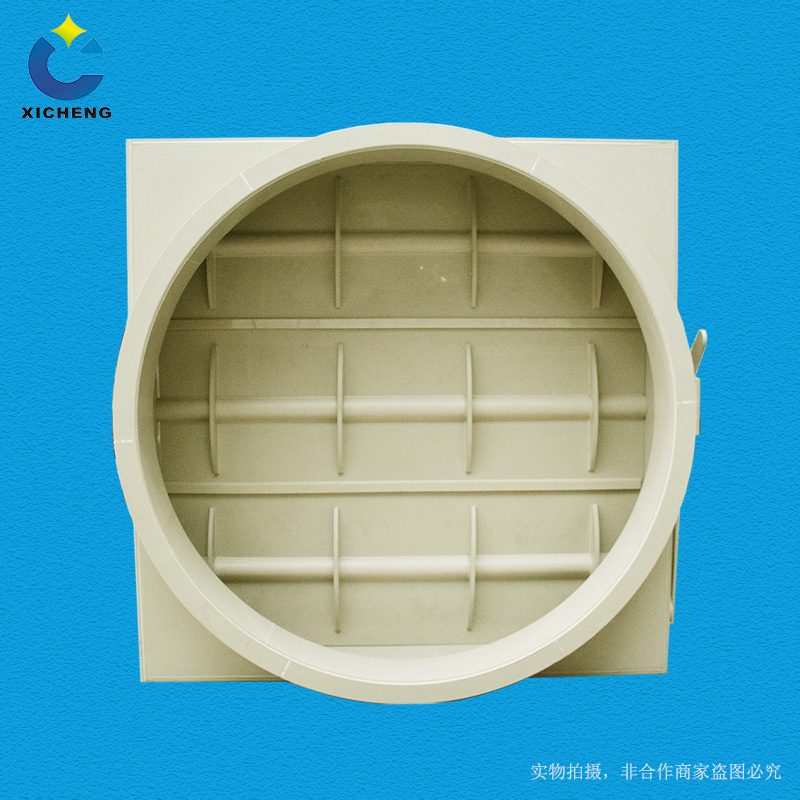
PP Processing Damper
| Product Model | PP board welded round manual air valve |
|---|---|
| Category | PP Machined Products |
| Reference Price | Price on request |
Product Overview
The PP processing damper is a circular airflow regulating valve constructed by rolling and welding PP sheet material to form the valve body, then assembling the vane, shaft, and manual mechanism. Unlike injection-molded dampers, its size and structure are not limited by molds, allowing the production of large-diameter, thick-walled, special-length, and custom connection size dampers. It is primarily used for large-diameter main pipes and non-standard equipment interfaces that fall outside the scope of standard series.
The damper adjusts airflow by rotating the vane within the cylinder using an external handle or worm gear mechanism, thereby changing the flow cross-section to regulate airflow and control the air path. The plate-welded valve body adopts the same materials and processes as the processed ductwork, featuring continuous welds and a smooth inner surface, enabling seamless welding or flange connection with the ductwork for unified corrosion resistance. For large-diameter valves, the vane employs a double-layer reinforced structure, a thickened shaft, and bearings at the shaft seat to ensure stable operation and prevent vibration or jamming under wind pressure.
Xicheng Environmental can customize PP round manual dampers based on drawings and operating conditions, with adjustable nominal diameter, wall thickness, flange standards, vane designs, and operating mechanisms. Inspection ports and position indicators can also be provided on the valve body. The product is suitable for large-diameter corrosion-resistant exhaust pipelines in chemical, electroplating, and environmental treatment projects for airflow regulation and isolation.
Working Principle
The processing damper adjusts airflow by changing the local resistance in the pipeline through the angular displacement of the vane. As the vane rotates around the shaft, it is fully closed when perpendicular to the airflow and fully open when parallel, with intermediate angles corresponding to different openings. Reducing the vane angle increases local resistance, decreasing airflow in that branch, thus achieving balanced airflow distribution and total airflow regulation. Large-diameter vanes with a larger wind area require shafts and shaft seats to withstand significant aerodynamic torque, which is a key focus of structural reinforcement in processing dampers.
The corrosion resistance of plate-welded dampers comes from the PP material and matching welds. Both the valve body and vane are made of polypropylene, resistant to acid and alkali gas corrosion, rust, and jamming. Even if the vane edges are exposed to corrosive gases for long periods, they maintain their shape. Large-diameter vanes are designed with reinforced double-layer or arched structures to enhance rigidity, preventing flutter and noise in airflow. The shaft is coated with corrosion-resistant material or made of corrosion-resistant material, and the shaft seat seal minimizes air leakage through the shaft bore.
Structural Components
The processing damper consists of a plate-welded valve body, vane, shaft, shaft seat, operating mechanism, and flanges. The valve body is a PP sheet-welded cylindrical tube with continuous longitudinal seams, with flanges welded at both ends or a socket formed. The vane is a circular plate, with large-diameter vanes featuring welded reinforcement or a double-layer structure, mounted on a shaft passing through the valve body. The shaft is supported by shaft seats fixed to the valve body exterior, which include shaft sleeves and seals.
The operating mechanism uses a handle for direct drive and position locking on small-diameter valves, while large-diameter valves employ worm gear or gear mechanisms for deceleration, offering effortless operation with self-locking capability. A soft seal can be added to the vane edges to improve air tightness. Reinforcement rings can be welded to the valve body exterior to withstand negative pressure, and flanges are drilled according to pipeline standards. For automated control, the same plate-welded valve body can be retrofitted with an electric actuator to become a processing electric damper.
Specification Model Table
The following table compares the characteristics of processing dampers and injection-molded dampers. Specific diameters are matched with ductwork.
| Item | Plate-Welded Processing Damper | Injection-Molded Formed Damper |
|---|---|---|
| Diameter Range | Large Non-Standard | Standard Series |
| Vane Structure | Can Be Reinforced | Standard Single Plate |
| Operating Mechanism | Handle / Worm Gear | Primarily Handle |
| Application | Non-Standard Main Pipes | Standard Branch Pipes |
Product Features
The PP processing damper is unconstrained in diameter and structurally reinforced, making it a specialized regulating valve for large-diameter non-standard corrosion-resistant air pipes. Its main features include:
- PP sheet-welded construction, customizable nominal diameter, wall thickness, and length
- Suitable for large-diameter main pipes outside standard series
- Vane reinforcement and shaft thickening for stable operation under high wind pressure
- Worm gear mechanism for large-diameter valves, offering effortless operation with self-locking
- Corrosion-resistant to acid and alkali, with welds and ductwork having equal service life
- Flanges available for socket or welding, matching processed ductwork
- Inspection ports can be reserved, or electric actuators can be retrofitted
| Body Material | PP Sheet |
|---|---|
| Processing Technology | Roll Forming and Welding Assembly |
| Section Shape | Round |
| Drive Type | Handle / Worm Gear Manual |
| Valve Disc Structure | Single / Reinforced with stiffeners |
| Connection Method | Flange / Butt-welding |
| Corrosion resistance performance | Acid and Alkali Salt Resistant |
| Specifications and Features | Large-diameter custom-made |
| Customizable | Electric Actuator |
| Sealing Options | Valve disc edge soft seal |
| Thickness of Sheet Material | Select by Nominal Size |
Application Industries
- Large-diameter regulating valves for main trunk ducts of high-capacity ventilation in chemical plants
- Non-standard isolation valves for fan inlets and outlets in environmental protection engineering
- Corrosion-resistant discharge main duct damper for electroplating workshops with large diameter
- Regulating valves for ducts with diameters outside the standard series
- Non-standard circular interface dampers for towers and purification equipment
- Irregular size replacement dampers for renovated corrosion-resistant ducts
- High-position large-diameter valves requiring worm gear for labor-saving operation
Typical Process Locations
Processing dampers are installed at large-diameter circular main trunk ducts, fan inlets and outlets, and non-standard equipment interfaces, performing air volume regulation and maintenance isolation. Space must be reserved for the operation and maintenance of the actuation mechanism. High-positioned large-diameter valves are equipped with worm gear mechanisms and operating chains or platforms. The valve's flanges at both ends are aligned with the processing ducts for connection. The valve's weight and operating force are borne by the pipeline supports, and the heavy-duty worm gear mechanism is supported by an independent stand.
During system commissioning, large-diameter dampers are typically used for coarse adjustment of total and regional air volume, while branch duct small valves are used for fine balancing. During maintenance, main trunk valves are closed to isolate equipment before and after, and soft-sealed valve plates reduce air leakage. For large-diameter pipe sections requiring remote or automatic control, specify the actuator model and control method at the time of order. The same plate-welded valve body is paired with an electric actuator. Before installation, verify the diameter, flange standards, and valve plate type. Manually rotate the valve plate to ensure smooth movement without obstruction, then align and tighten with the pipeline. The actuation mechanism and actuator weight of large-diameter valves are supported by independent brackets to avoid prolonged pressure on flanges and pipelines. Regularly inspect valve plate sealing, bushings, and locking devices during operation; clean dust or crystallization before operation.
Standard plate welded damper has a gap between the vane and the casing, primarily used for airflow regulation. It still allows air leakage when fully closed and cannot achieve airtight isolation. For airtight isolation, corrosion-resistant soft sealing strips should be added to the edge of the vane, ensuring the sealing strips press against the casing when the vane is fully closed. A worm gear or electric actuator capable of providing sufficient closing torque should be paired to manufacture airtight processed dampers. For maintenance isolation and preventing gas backflow, the airtightness requirement must be specified during ordering, and standard regulating valves cannot replace airtight valves. The sealing type, vane rigidity, and closing force of airtight valves must be matched in design, and the soft sealing material must be resistant to exhaust corrosion. When selecting, distinguish between regulating and isolation purposes. If both regulation and isolation are required, separate regulating valves and airtight valves can be installed, or a specialized valve that combines both functions can be selected.
Related Products
View More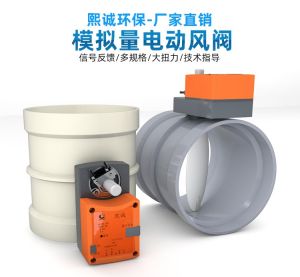 Hot
Hot
PP Fire-Resistant Analog Air Valve
 Hot
Hot
PP Fire-Resistant Closed-Check Valve
 Hot
Hot
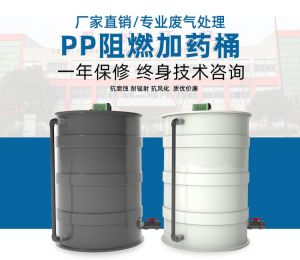
PP Flame Retardant Additive Drum
 Hot
Hot
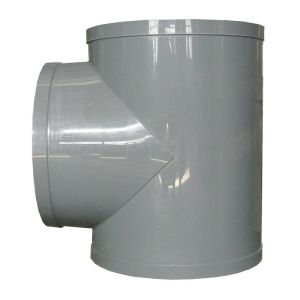
PP Flame Retardant Processed T-Connector
Get Quote
PP Flame Retardant Processed T-Connector / PP board welded round manual air valve