
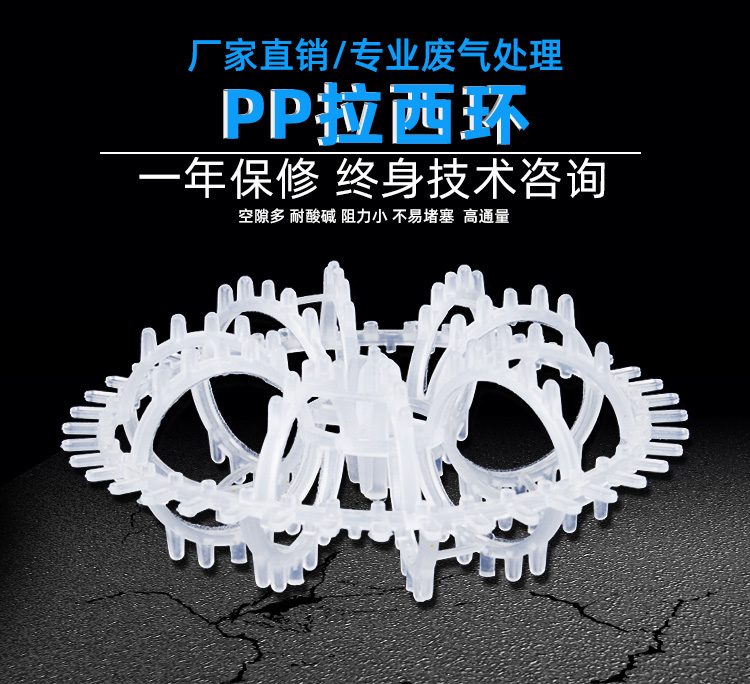
PP Raschig Ring
| Product Model | Bulk Ring Fill Series |
|---|---|
| Category | PP Molded Products |
| Reference Price | Price on request |
Product Overview
PP Raschig rings are a structurally simple ring-shaped bulk packing, featuring thin-walled hollow cylinders with heights equal to their diameters, molded from polypropylene. During use, a large number of Raschig rings are randomly stacked in the packing layer of scrubbing towers, absorption towers, and regeneration towers. Waste gas and absorbent flow through the voids between the rings and the inner holes of the rings, completing the mass transfer and purification process.
Raschig rings are an early-developed and widely applied classic packing type, characterized by simple structure, easy processing, and low cost. The ring structure allows both the interior and surface of the packing to participate in gas-liquid contact. Randomly stacked packing forms tortuous flow paths, extending the residence time of gas within the packing layer. The PP material is resistant to acid, alkali, and salt corrosion, lightweight, and not easily broken, making it suitable for treating corrosive exhaust gases and offering significant advantages over metal packing in applications prone to rust.
Xicheng Environmental supplies PP Raschig rings in multiple diameter specifications. Smaller specifications result in more packing units per unit volume and larger specific surface area, but also increased resistance. Larger specifications offer higher throughput and resistance to blockage, making them suitable for dusty or sticky gas streams. Selection should be based on tower diameter, gas treatment capacity, and purification requirements to determine the packing specification and loading height.
Working Principle
The purification effect of Raschig ring packing comes from the thorough contact between the gas and liquid phases on the packing surface. Absorbent is sprayed downward from above the packing layer, forming a liquid film on the ring surface and filling part of the internal space. Waste gas rises from below through the tortuous channels formed by the randomly stacked packing, continuously contacting the wetted ring wall liquid film, where pollutants in the gas phase are absorbed or neutralized by the liquid phase, achieving gas purification.
A large number of randomly stacked Raschig rings provide a specific surface area far greater than that of an empty tower. The more developed the liquid film and the larger the gas-liquid contact area, the more thorough the mass transfer. The hollow structure of the ring ensures a high voidage, allowing gas to pass through multiple paths via the inner holes and inter-ring voids, resulting in high throughput and low resistance. The PP material is not corroded by the absorbent, maintains stable wettability, ensures uniform liquid film distribution, and retains the packing shape and void structure over long-term operation.
Structural Composition
Each Raschig ring is a thin-walled cylindrical tube with equal diameter and height, open at both ends and hollow in the middle, with a smooth wall surface. Plastic Raschig rings are molded from molds, ensuring uniform wall thickness, round ring bodies, and consistent dimensional accuracy in batch production. The ring wall can be smooth, or modified products with windows or ribs on the wall surface may be used to improve internal surface wetting and liquid distribution.
The packing layer consists of tens of thousands of randomly stacked individual Raschig rings, supported by grating plates or porous plates at the bottom, and sometimes limited by pressure plates at the top if necessary. Randomly interlocking Raschig rings form numerous void channels. During loading, wet or dry methods are used to ensure uniform density throughout the layer, avoiding voids and wall flow. When packing layers of different specifications are stacked, support members are installed between layers.
Specification Model Table
The following table provides a general comparison of Raschig ring specifications and their applicable characteristics. Specific dimensions should be based on actual products and selection calculations.
| Specification Tendency | Specific Surface Area | Applicable Characteristics |
|---|---|---|
| Small Diameter | Larger | High purification requirements for relatively clean gas |
| Medium Diameter | Medium | General acid-alkali gas scrubbing |
| Large Diameter | Smaller | High throughput, anti-blocking, dusty gas |
Product Features
PP Raschig rings feature a mature structure, are economical and durable, and are a common bulk packing for acid-alkali gas scrubbing towers. Key features include:
- Classic ring structure, high throughput, low pressure drop
- PP injection molded, resistant to acid, alkali, and salt corrosion, does not rust
- Lightweight, low labor intensity for loading and replacement
- Smooth wall surface, resistant to scaling and blockage, easy to clean
- Low cost, ample supply, low replacement cost
- Multiple diameter specifications, adaptable to different tower diameters and gas flows
- Not easily broken, low transport and loading loss
| Material | PP Polypropylene |
|---|---|
| Molding Process | Injection Molding |
| Appearance | Elevated Hollow Circular Ring |
| Filling Method | Improperly stacked loading |
| Corrosion resistance performance | Acid-alkali-resistant |
| Installation Location | Tower packing layer |
| Support Component | Grid Plate / Perforated Plate |
| Purpose | Packed tower |
| Color | Porcelain White / Transparent |
| Structural Features | Large gap, high flow rate |
| Outer Diameter Specification | Multiple size options available |
Application Industries
- Mass Transfer Packing for Acid-Base Exhaust Scrubbers in Electroplating Industry
- Filler for Hydrogen Chloride and Ammonia Absorption Towers in Chemical Enterprises
- Filler for Acid-Base Vent Purification Towers in Semiconductor and PV Factories
- Acid Mist Purification Tower Filler Layer for Metallurgical Pickling Lines
- Reaction Tail Gas Absorption and Solvent Scrubbing Filler for Pharmaceutical Plants
- Odor Spray Scrubber Filler for Wastewater Treatment Plants
- Filler for Small Scale Filler Towers in Laboratory Fume Treatment
Typical Process Location
Larox Ring is installed in the packing layer of the middle section of scrubbing towers and absorption towers, located between the upper and lower layers of spray pipes or below the spray pipes, supported by a grating at the bottom. The exhaust gas enters from below the packing layer, rises through the Larox Ring bed, while the absorbing liquid sprays downward from above. The gas and liquid come into countercurrent contact in the voids of the packing, and the purified gas continues to rise through a demisting layer for discharge.
During the equipment loading process, after the tower body and support grating are installed, Larox Ring is poured from the manhole or the top of the tower and leveled to the design height. After leveling the surface, the upper pressure plate and spray device are installed. When replacing the packing, the manhole is opened to remove the old packing, inspect the grating and tower wall, and then re-load the packing. The quality of packing loading directly affects gas-liquid distribution and purification efficiency. It should be avoided to have local voiding and uneven density. Before loading, confirm that the ring diameter matches the tower diameter, ensure the Larox Ring is clean and free of fragments, and use wet loading or batch loading to minimize damage and bridging. The bed surface should be leveled and the loading height controlled. During operation, liquid distribution is observed through sight glasses, blockage is judged by pressure drop, and the packing is cleaned regularly. Broken, deformed, and heavily clogged old rings are screened out, and new rings are added and leveled again to ensure uniform gas-liquid contact across the entire cross-section.
Related Products
View More Hot
Hot
PVC Flexible Duct Connector
 Hot
Hot
PVC Plastic Damper
 Hot
Hot
PP plastic ring
 Hot
Hot
PP Manual Damper
Get Quote
PP Manual Damper / Bulk Ring Fill Series