
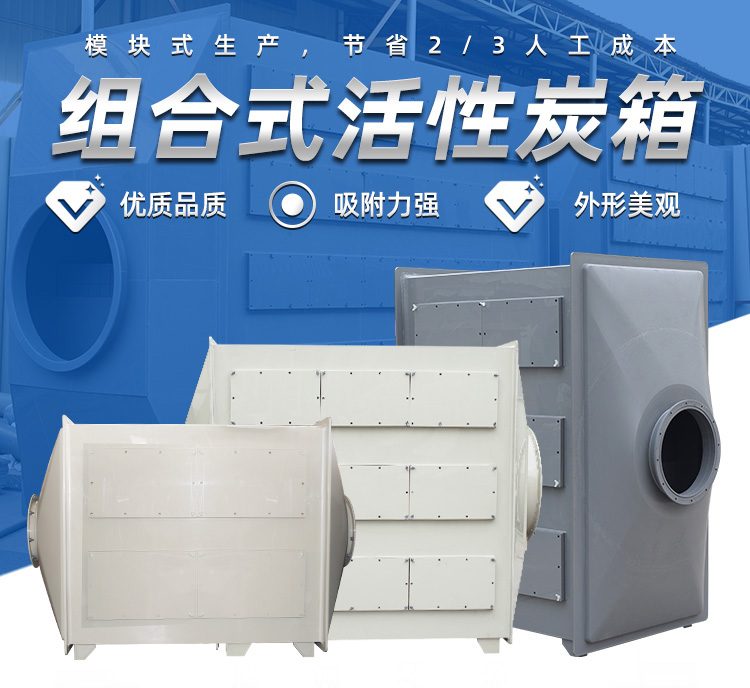
Drawer-type activated carbon adsorption box
| Product Model | Drawer type activated carbon adsorption unit |
|---|---|
| Category | Waste Gas Treatment Equipment |
| Reference Price | Price on request |
Product Overview
The drawer-type activated carbon adsorption unit is a dry purification equipment that utilizes the adsorption effect of activated carbon to treat organic waste gas and odors. The housing is constructed with PP, PPs, or anti-corrosion carbon steel. Internally, it features multiple removable activated carbon drawers (adsorption units), each filled with honeycomb or granular activated carbon. Under negative pressure generated by the fan, organic waste gas enters the housing and sequentially passes through each layer of activated carbon adsorption. Volatile organic compounds (VOCs) and odor molecules in the gas are adsorbed and trapped by the highly porous surface of the activated carbon, and the purified gas is discharged through the fan and exhaust stack for high-altitude release.
The drawer-type structure is a standout feature of this equipment: activated carbon is loaded into drawers equipped with grilles. The drawers slide into the housing along rails and are sealed by compression. Once the activated carbon reaches adsorption saturation, the service door can be opened to withdraw the adsorption unit like pulling a drawer, replacing or regenerating the carbon material, and then sliding it back in. No personnel need to enter the housing, ensuring quick replacement, uniform carbon loading, and reliable sealing. The equipment can be equipped with honeycomb activated carbon (low pressure drop, large gas contact area, suitable for high airflow) or granular activated carbon (high adsorption capacity, suitable for low airflow and high concentration), selected based on waste gas properties and airflow.
Xicheng Environmental can design drawer-type activated carbon adsorption units based on treatment airflow, pollutant types, and concentrations, determining the amount of activated carbon to be loaded, the number of layers, and the residence time. The housing can be made of anti-corrosion and flame-retardant PP or PPs material, equipped with inlets and outlets, service doors, pressure differential sensors, and replacement indicators. It is suitable for purifying low-concentration, high-airflow organic waste gas and odors in industries such as painting, printing, chemical, and pharmaceutical manufacturing, often serving as end-of-pipe compliance or emergency treatment equipment.
Working Principle
Activated carbon adsorption is a physical adsorption process. After activation, activated carbon develops highly developed micropore structures and a vast specific surface area. As waste gas passes through the activated carbon layer, VOCs and odor molecules diffuse into the pores and are fixed by molecular forces (Van der Waals forces) on the pore surfaces, transferring pollutants from the gas phase to the solid-phase activated carbon, thereby purifying the gas. The straight-through small pores of honeycomb activated carbon and the interstitial gaps of granular carbon provide a large contact surface, allowing the waste gas to fully contact the activated carbon during its residence time in the adsorption layer.
Adsorption is a dynamic equilibrium process. The adsorption capacity of activated carbon is limited, and the adsorption front gradually moves toward the outlet during operation. When the pollutant concentration at the outlet reaches the breakthrough point (saturation), the activated carbon loses its purification ability and needs to be replaced or desorbed. The drawer-type carbon unit ensures uniform carbon layer thickness and airflow distribution through its layered drawers, guaranteeing full utilization of the activated carbon in each drawer. The housing is located in the negative pressure section of the system, preventing unfiltered gas from leaking outward. Adsorption is a physical process; pollutants are merely concentrated on the carbon and not destroyed. Saturated activated carbon is classified as hazardous waste or must be managed according to regulations, requiring disposal or regeneration by qualified units and not being discarded arbitrarily.
Structural Components
The drawer-type activated carbon adsorption unit consists of a housing, activated carbon drawers, activated carbon, airflow distribution plate, service door, inlets and outlets, and sealing structure. The housing is a welded rectangular structure with reinforced outer walls, with one end for inlet and the other for outlet. Internally, multiple drawer rails are arranged along the airflow direction. The housing is equipped with a service door and a clamping mechanism, with the number of drawers and layers designed based on airflow and carbon layer thickness.
The activated carbon drawers are frame structures with grilles. The bottom and windward surfaces are made of porous plates or grids, internally filled with honeycomb or granular activated carbon. After insertion, sealing strips compress the perimeter, forcing all airflow to pass through the carbon layer without short-circuiting. An airflow distribution plate can be installed on the inlet side to ensure uniform gas entry into each drawer, while a static pressure box is left on the outlet side. The housing is equipped with a pressure differential gauge connection to monitor carbon layer resistance and may include sampling ports for detecting inlet and outlet concentrations. The PP or PPs housing is acid-base resistant and flame-retardant, equipped with support legs, lifting lugs, and a service platform.
Specification and Model Table
The following table compares the characteristics of honeycomb and granular activated carbons. The carbon type should be selected based on waste gas properties.
| Carbon Type | Features | Applicability |
|---|---|---|
| Honeycomb Activated Carbon | Direct-through channels, low resistance | High airflow, low concentration |
| Granular Activated Carbon | High capacity, flexible replacement | Low airflow, high concentration |
| Impregnated Modified Carbon | Targeted for specific gases | Acid-base or special waste gas |
Product Features
The drawer-type activated carbon adsorption unit features a simple structure, convenient carbon replacement, and stable purification efficiency, making it a common equipment for treating low-concentration organic waste gas and odors. Its main features are as follows.
- Physical adsorption by activated carbon, effective against multiple VOCs and odors
- Drawer-type loading, quick and easy carbon replacement
- Honeycomb carbon with low resistance, suitable for high-airflow organic waste gas
- Layered carbon layers with uniform airflow, maximizing adsorption capacity utilization
- Sealing strips ensure gas does not take short-circuits, preventing negative pressure leaks
- PP or PPs housing, acid-base resistant and flame-retardant
- Optional pressure differential and concentration monitoring to indicate carbon replacement needs
| Box material | PP / PPs / Corrosion-Resistant Carbon Steel |
|---|---|
| Adsorbent materials | Honeycomb / Granular Activated Carbon |
| Filling Method | Drawer type tiered |
| Purification Principle | Physical adsorption of activated carbon |
| Object Processing | VOC organic exhaust odor |
| Operating Pressure | Blower Negative Pressure |
| Sealing Method | Drawer Seal Compression Our drawer seal compression solutions are designed to provide optimal sealing performance for industrial |
| Monitoring Configuration | Pressure Differential / Sampling Port Optional |
| Replacement Method | Draw out the drawer to replace the carbon |
| Specifications and Features | Non-standard design based on airflow |
Application Industries
- Adsorption and Purification of VOCs in Paint and Coating Exhaust
- VOC Odor Treatment in Printing, Packaging, and Lamination Processes
- Control of Low-Concentration Organic Gases in Chemical and Pharmaceutical Workshops
- Adsorption of Exhaust Gases in Injection Molding and Screen Printing in Electronics and Plastics Industries
- Odor and Odor Purification in Wastewater Treatment Plants and Landfills
- Adsorption at the Exhaust End of Organic Ventilation Cabinets in Laboratories
- Deep Treatment of Residual Organic Gases After Spraying and Washing
Typical Process Locations
The activated carbon adsorption box is typically installed after pre-treatment (e.g., filtration cotton, washing tower) and before or after the fan. The organic exhaust gas is first pre-treated to remove dust, oil mist, and water mist (which can block activated carbon pores and reduce adsorption capacity) before entering the activated carbon box for VOC adsorption. The purified gas is then discharged through a fan and exhaust stack. High-concentration organic exhaust is generally not directly treated with activated carbon; it is often pre-treated through condensation, spraying, or adsorption concentration. The activated carbon box is primarily used for low-concentration, high-volume terminal compliance. Operation space for drawer extraction and carbon material handling is left around the box.
During installation, the box is placed horizontally, with the inlet and outlet directions aligned with the airflow indicators. Drawers are inserted one by one and sealed tightly. Before operation, record the initial pressure difference of the carbon layer and the loading date. During operation, monitor the pressure difference and outlet concentration. Replace the activated carbon promptly when resistance increases significantly or the outlet concentration approaches the emission limit. The saturated activated carbon removed must be collected and stored as hazardous waste or according to local regulations, transferred to a qualified unit for disposal or regeneration, and transfer records must be retained. Random dumping is strictly prohibited.
Related Products
View More Hot
Hot
V0 PPs Fire Retardant Activated Carbon Box
 Hot
Hot
SDG Dry Acid Mist Adsorption Box
 Hot
Hot
Flame Retardant Horizontal Spray Tower
 Hot
Hot
PP Scrubber
Get Quote
PP Scrubber / Drawer type activated carbon adsorption unit