
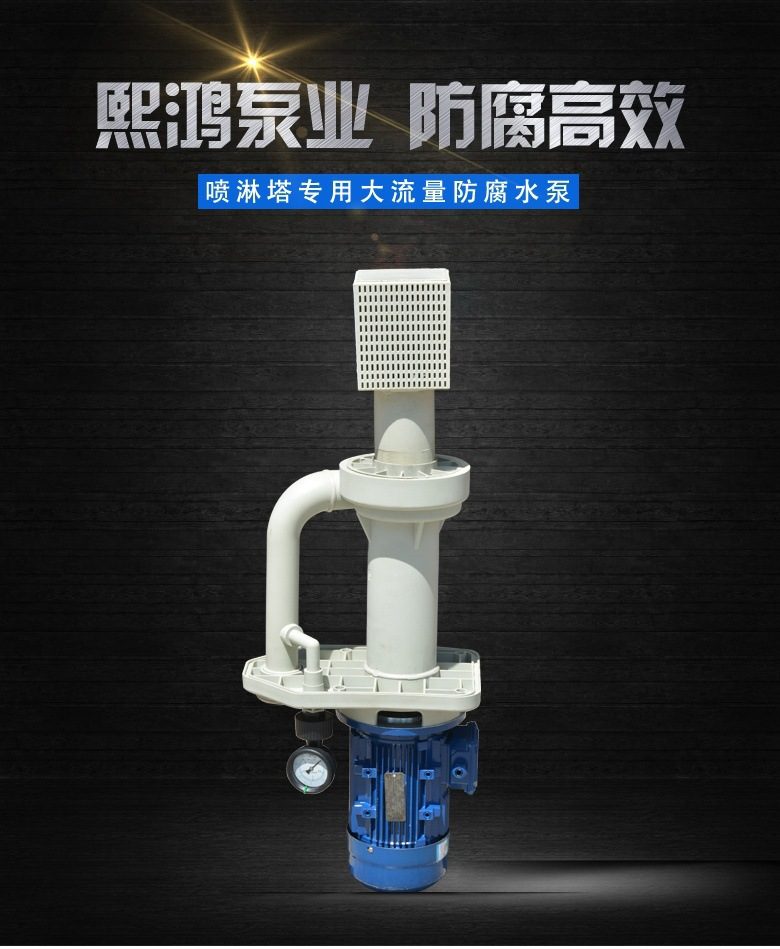
High-Flow Exhaust Tower Special Water Pump
| Product Model | Anti-corrosion circulating pump series |
|---|---|
| Category | Waste Gas Treatment Equipment |
| Reference Price | Price on request |
Product Overview
The high-flow exhaust tower water pump is a circulating pump specifically designed for wet exhaust treatment equipment such as spray towers, scrubbing towers, and acid mist purification towers. It is responsible for pressurizing and transporting the absorption liquid (alkaline solution, acidic solution, or clean water) from the bottom sump tank to each layer of spray pipe within the tower. The liquid is atomized and sprayed through nozzles, coming into contact with the exhaust before falling back into the sump for recycling. The characteristics of exhaust tower circulation include high flow rate, relatively low head, and the Conveyor medium containing acid or alkali with the potential to carry small particles. Therefore, dedicated pumps commonly use corrosion-resistant plastic materials such as PP and PVDF, designed as corrosion-resistant centrifugal pumps, distinguishing them from conventional clean water pumps.
Exhaust tower circulating pumps are typically available in two forms: vertical sump pumps (submersible pumps) and horizontal corrosion-resistant pumps. Vertical sump pumps have their pump body directly installed on the top plate of the sump, with the impeller partially immersed in the liquid, while the motor is located above the liquid surface. They employ an axial seal-free structure, eliminating mechanical seal leakage issues and making them less prone to damage during short-term dry running. These pumps save floor space and are the most commonly used type for spray towers. Horizontal corrosion-resistant pumps are installed on the ground beside the sump, drawing water from the sump through suction pipes, equipped with mechanical seals, and offering convenient maintenance. Both types of pumps have all flow-through components made of acid/alkali-resistant materials, suitable for corrosive circulating liquid environments.
Xicheng Environmental Protection provides high-flow exhaust tower water pumps tailored to the treatment air volume of spray towers, the number of spray layers, the number of nozzles, and the required spray pressure to determine flow rate and head. The pump body material is selected based on the composition and temperature of the circulating liquid. These pumps can be supplied as complete sets with spray towers, along with Complementary valves, pipelines, and spare pumps, ensuring continuous and reliable operation of the spray circulation system.
Working Principle
Exhaust tower water pumps are centrifugal pumps. Their working principle involves the high-speed rotation of the impeller driving the liquid inside the pump. Under centrifugal force, the liquid is thrown from the center of the impeller to its outer edge, gaining pressure energy and kinetic energy. As it enters the volute, it slows down and increases in pressure before being discharged into the spray pipeline. A low-pressure area forms at the center of the impeller, and the liquid from the sump is continuously drawn into the impeller through the inlet pipe or the lower part of the pump body, achieving continuous liquid transport and circulation. The motor drives the impeller rotation through a long shaft (vertical) or coupling (horizontal).
In an exhaust tower system, the pump pressurizes the circulating liquid to the spray pipeline. The liquid forms fine droplets and is evenly sprayed across the entire tower cross-section through the nozzles, providing liquid film and washing liquid to the packing layer. After gas-liquid absorption, the liquid falls back to the bottom sump of the tower under gravity, and the pump then draws liquid from the sump, creating a closed-loop circulation. Vertical sump pumps, with their impeller submerged and axial seal eliminated, rely on the liquid itself for lubrication and cooling, eliminating issues of seal corrosion and leakage from acid or alkali. They also allow for brief dry running. The pump's flow rate and head characteristics must match the resistance of the nozzles and pipelines to ensure stable pressure and atomization effects at each spray layer. Insufficient flow rate can lead to dry zones in the packing and reduced purification efficiency.
Structural Components
The high-flow exhaust tower water pump consists of an motor, pump body, impeller, pump shaft, inlet and outlet, installation plate or base, and sealing structure. For vertical sump pumps, the upper part is a standard motor, with the motor housing fixed to the top plate of the sump. A long shaft extends downward into the sump, while the lower part consists of the pump body and impeller submerged below the liquid surface. The outlet pipe runs along the side of the pump to connect to the spray pipeline, employing an axial seal-free (no mechanical seal) structure.
The pump body, impeller, volute, and outlet pipe are made of corrosion-resistant plastics such as PP, PVDF, or FRPP through injection molding or forming, resistant to acid, alkali, and salt corrosion. The impeller is typically closed or semi-open centrifugal, with the semi-open design offering better resistance to impurities. A reliable isolation and protection is provided between the motor and the pump body to prevent corrosion from acidic gases and liquids. Horizontal pumps are equipped with a pump base, coupling, mechanical seal, and suction pipe, along with a bottom valve or water-priming device. The pump's inlet and outlet are connected to pipelines and valves via flanges or threads, with on-site installation of valves, flexible connectors, pressure gauges, and filters. Critical systems are equipped with one primary and one spare pump.
Specification Model Table
The following table compares the characteristics of vertical sump pumps and horizontal corrosion-resistant pumps for selection based on installation conditions.
| Item | Vertical Sump Pump | Horizontal Corrosion-Resistant Pump |
|---|---|---|
| Installation | Submerged in sump top plate | Ground foundation |
| Axial Seal | No axial seal, no leakage | Mechanical seal |
| Dry Running | Allows brief dry running | Prohibits dry running without water |
| Maintenance | Requires lifting and removal | Easy ground maintenance |
Product Features
The high-flow exhaust tower water pump is corrosion-resistant, acid/alkali-resistant, high-flow, and operates reliably, serving as a key Complementary for stable purification of spray towers. Its main features are as follows.
- Flow-through components made of PP or PVDF, resistant to acid/alkali/salt corrosion
- High flow rate, low head, matched with multi-layer nozzles of spray towers
- Vertical axial seal-free structure, no leakage, allows brief dry running
- Installed in sump, saves space, reliable suction without priming
- Impeller designed for anti-blocking, suitable for small impurities in circulating liquid
- Complements spray towers for stable spray pressure
- Comprehensive specifications, can be paired with valves, pipelines, and spare pumps
| Pump Type | Anti-corrosion Centrifugal Pump |
|---|---|
| Common Forms | Vertical Tank / Horizontal Tank |
| OverflowMaterial | PP / PVDF / FRPP |
| Transport Medium | Acid-Base Absorption Liquid Circulating Water |
| Flow Characteristics | High-traffic |
| Head characteristic | Low-to-Medium Head |
| Sealing Form | Vertical Shaftless Seal |
| Purpose | Spray Tower Circulating Spray |
| Configuration | Valves and pipelines are optional |
| Specifications and Features | Select based on spray volume |
Application Industries
- Absorption liquid circulation spraying in spray towers and Washing towers
- Alkali liquid circulation conveying in acid mist purification towers
- Circulation water pump matching for PP exhaust gas purification towers
- Circulation water supply for horizontal spray towers and packing towers
- Corrosion-resistant reagent circulation conveying in chemical plating workshops
- Chemical addition and corrosion-resistant liquid conveying in wastewater treatment
- Backup pump and replacement matching for exhaust gas treatment systems
Typical Process Locations
The vertical tank-mounted pump is installed on the top plate of the spray tower's circulation water tank. The pump body and impeller are immersed below the water level through openings in the top plate, while the motor is located above the top plate. The liquid outlet is connected via valves and pipelines to the main spray pipes on each layer of the tower. The horizontal pump is installed on a foundation beside the water tank, with the suction pipe drawing water from the bottom of the tank and the outlet connected to the spray pipes. A filter screen should be installed near the pump's suction inlet or inside the tank to prevent filler fragments and impurities from entering the pump body and nozzles. The outlet is equipped with valves, pressure gauges, and necessary soft connections. Before returning to the tank, the circulating liquid passes through the sedimentation area of the tank. Critical systems are equipped with two pumps (one in use and one on standby) with automatic switching.
During installation, the vertical pump must be ensured to be vertically aligned, with the immersion depth meeting requirements and a certain distance from the tank bottom and walls. The liquid discharge pipe must be independently supported to avoid transferring the weight of the pipeline to the pump. For horizontal pumps, ensure the suction pipe is airtight, with proper priming or reliable bottom valves. Before startup, check the water level and rotation of the tank. First confirm the submersible pump is immersed, then open the outlet valve before starting. During operation, monitor pressure, current, vibration, and noise. Horizontal pumps must not run dry or with blocked inlets. Daily checks should include verifying normal flow and pressure, checking for motor overheating, abnormal vibration, and leaks.
Related Products
View More Hot
Hot
V0 PPs Fire Retardant Activated Carbon Box
 Hot
Hot
SDG Dry Acid Mist Adsorption Box
 Hot
Hot
Flame Retardant Horizontal Spray Tower
 Hot
Hot
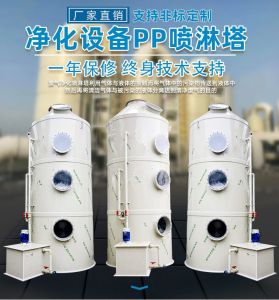
PP Scrubber
Get Quote
PP Scrubber / Anti-corrosion circulating pump series