
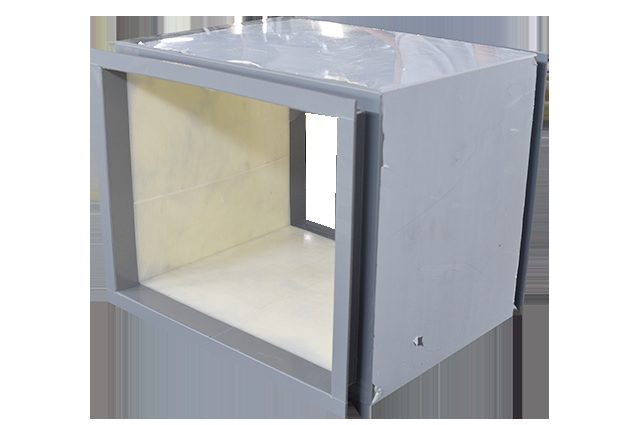
Square duct muffler
| Product Model | Rectangular Resistive Disc Muffler |
|---|---|
| Category | PP Machined Products |
| Reference Price | Price on request |
Product Overview
The square duct muffler is a noise reduction device installed in rectangular anti-corrosion ventilation ducts, designed to reduce fan and airflow noise. It has a rectangular box shape with an outer shell made of flame-retardant PP sheets folded and welded. Internally, multiple sound-absorbing panels filled with acoustic materials are parallelly arranged. As airflow passes through the channels between these panels, sound energy is absorbed and converted by the acoustic materials, thereby reducing the fan noise propagating along the duct. The rectangular cross-section matches that of the square duct, with square flanges at both ends for connection.
In anti-corrosion exhaust systems, noise generated by fan impeller rotation and airflow pulsation travels along the duct to the workshop and exhaust stack outlet, affecting the operating environment and compliance with factory boundary noise standards. Resistive mufflers are highly effective in reducing mid-to-high frequency noise and are the most commonly used form for fan noise control. The greater the number of sound-absorbing panels, the narrower the inter-panel channel, and the longer the muffler, the higher the noise reduction performance, but the corresponding pressure drop also increases. A balance must be struck between noise reduction and energy consumption. The PPs outer shell is acid and alkali-resistant and self-extinguishing, making it suitable for corrosive exhaust systems.
Xicheng Environmental can design and manufacture square pleated mufflers based on fan airflow, noise spectrum, and rectangular duct dimensions. The channel velocity, panel spacing, and muffler length are determined to achieve the target noise reduction. The sound-absorbing panels are protected by anti-corrosion perforated panels or corrosion-resistant facing materials to prevent fibers from being carried away by airflow. Square flanges and maintenance structures are provided at both ends, and the impedance compound form can also be combined to broaden the noise reduction frequency band.
Working Principle
The square muffler primarily utilizes the principle of resistive absorption. The internal sound-absorbing panels are filled with porous acoustic materials and have a perforated protective panel surface. As airflow carrying noise travels through the channels between the panels, sound waves enter the pores of the acoustic material, causing the air and fibers inside to vibrate. Sound energy is converted into minor heat energy through friction and viscous effects and dissipated, weakening the reflected sound waves. With each section of the sound-absorbing channel, sound energy is continuously attenuated, and the longer the muffler, the greater the noise reduction.
Resistive mufflers are particularly effective against mid-to-high frequency noise because high-frequency sound waves have short wavelengths and are easily absorbed by porous materials. They are relatively less effective against low-frequency noise. When low-frequency components are prominent, the thickness of the sound-absorbing panels can be increased, or an impedance compound structure (adding reactive expansion chambers or resonant chambers to the resistive channels) can be used to broaden the noise reduction frequency band. The PPs outer shell and corrosion-resistant facing ensure that the sound-absorbing material is not wetted or hardened by corrosive gases. The perforated facing panels prevent fiber dispersion, maintaining the stability of the sound-absorbing panel structure and preventing rapid degradation of sound absorption performance in corrosive environments.
Structural Components
The square muffler consists of a rectangular outer shell, sound-absorbing panels, protective facing structure, end flanges, and maintenance parts. The outer shell is formed by folding and welding PP sheets into a rectangular box with reinforcing ribs and is equipped with square flanges at both ends for connection to the rectangular duct. The sound-absorbing panels are long rectangular strips installed parallelly, filled with acoustic cotton or materials, and covered with a corrosion-resistant perforated protective panel and protective fabric to prevent the sound-absorbing material from being carried away by airflow.
The ends of the sound-absorbing panels can be designed as wedges or streamlined flow guides to reduce local resistance and regenerative noise as airflow enters the inter-panel channels. Several equally wide airflow channels are formed between the panels, and the panel spacing is determined based on the controlled velocity. The outer shell is equipped with inspection doors or removable end plates for easy inspection and replacement of the sound-absorbing material. For wide-frequency noise reduction, an impedance compound muffler can be formed by combining reactive chambers or micro-perforated structures with the resistive panel structure.
Specification Model Table
The following table shows the influence patterns of the main design parameters of the muffler, with specific calculations based on noise reduction requirements.
| Parameter | Increase Impact | Design Principle |
|---|---|---|
| Noise Reduction Length | Noise reduction increases | Based on target noise reduction |
| Panel Spacing | Narrow spacing improves noise reduction | Balance flow velocity and pressure drop |
| Channel Velocity | High velocity causes regenerative noise | Control economical velocity |
Product Features
The square duct muffler combines resistive and absorptive noise reduction, anti-corrosion and flame-retardant properties, and is designed for compatibility with rectangular ducts, making it a common device for fan noise control. Its main features are as follows.
- Resistive panel structure, effective in reducing mid-to-high frequency fan noise
- PPs board outer shell, acid and alkali-resistant and self-extinguishing
- Rectangular cross-section with square flanges, directly compatible with rectangular ducts
- Anti-corrosion and anti-flight protective facing for sound-absorbing panels, ensuring stable performance
- Streamlined panel tips reduce resistance and airflow regenerative noise
- Panel spacing and length are custom-designed based on airflow and noise
- Can be configured as an impedance compound structure to broaden low-frequency noise reduction
| Outer housing material | PPs Flame Retardant Boards |
|---|---|
| Section Shape | Rectangle |
| Sound Attenuation Principle | Resistance absorption as the main feature |
| Internal Structure | Parallel Silencer Sheet |
| Sound Absorbing Material | Porous acoustic absorption material |
| Face Protection Form | Anti-corrosion Perforated Protective Panel |
| Connection Method | Square Flange |
| Effective Bandwidth | Mainly medium and high frequency |
| Corrosion resistance performance | Acid and Alkali Salt Resistance |
| Flame Retardancy | Self-extinguishing |
| Spacing between chips | Based on noise spectrum design |
Application Industries
- laboratory rectangular exhaust fan muffler
- electroplating workshop anti-corrosion exhaust fan inlet/outlet muffler
- semiconductor plant rectangular exhaust duct fan noise reduction
- chemical workshop indoor anti-corrosion fan noise control
- ceiling-mounted rectangular exhaust dry pipe pleated muffler
- factory boundary exhaust stack rectangular pipe muffler section
- impedance composite muffler applications requiring low-frequency performance
Typical Installation Locations
Rectangular mufflers are installed between the rectangular ductwork and the fan or at the fan outlet pipe section. Common configurations involve placing an inlet muffler after the fan's flexible connection and an outlet muffler at the fan's exit, maximizing noise blockage along the ductwork in both directions. For workshop noise reduction, they are installed on the fan's inlet side, while for factory boundary exhaust stack noise compliance, they are placed near the exhaust stack on the outlet side. Flexible connections are used to isolate the muffler from the fan, preventing vibration transfer that could cause shell regenerated noise.
During installation, the muffler's orientation follows airflow indicators. Square flanges must be centered for airtight sealing, and the muffler's shell and ductwork should be independently supported. The muffler's weight must not rest on the fan or flexible connection. The flow velocity inside the muffler must be controlled within the recommended range, as excessive velocity can generate airflow regenerated noise, counteracting muffling effectiveness. Inspection doors should face the operational side. Regular checks are required to ensure acoustic panels are free of dust accumulation, moisture, or damaged protective surfaces. Dust-laden gases should be filtered or washed before entering the muffler to prevent acoustic hole blockage, which would reduce muffling performance.
Related Products
View More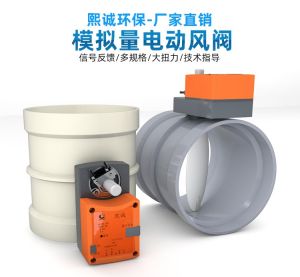 Hot
Hot
PP Fire-Resistant Analog Air Valve
 Hot
Hot
PP Fire-Resistant Closed-Check Valve
 Hot
Hot
PP Flame Retardant Additive Drum
 Hot
Hot
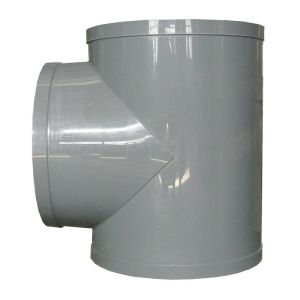
PP Flame Retardant Processed T-Connector
Get Quote
PP Flame Retardant Processed T-Connector / Rectangular Resistive Disc Muffler