
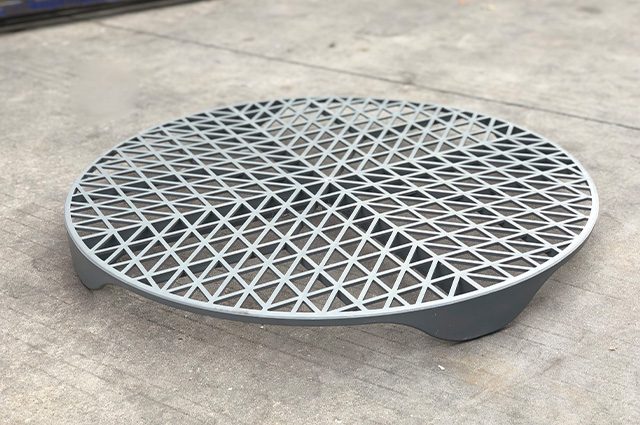
Integral Grating Plate
| Product Model | 注塑格栅板系列 |
|---|---|
| Category | PP Molded Products |
| Reference Price | Price on request |
Product Overview
Integral grating plates are plastic support components used internally in spray towers, washing towers, and absorption towers to bear the packing layer. The grating plates are laid on the supporting rings inside the tower, with loose bulk fillers such as Raschig rings and multi-sphere packing placed on top, while gas-liquid channels are left below. They not only bear the weight of the packing and liquid hold-up but also allow gas to pass upward and liquid to flow downward uniformly, making them a key internal component of packed towers.
Traditional grating plates are often made of PP strips cut and welded manually, which is time-consuming, has many weld seams, and exhibits uneven hole openings. Integral grating plates are made of flame-retardant PP through injection molding in one piece. The grating holes on the plate surface are arranged regularly, with high and consistent hole opening rates. The plates are assembled together using clips or overlapping joints, eliminating the need for on-site welding, saving labor, and shortening the equipment manufacturing cycle.
The integral grating plates supplied by Xicheng Environmental Protection are made of flame-retardant materials, corrosion-resistant, lightweight, and have a smooth surface. The dimensions of individual plates are standardized and can be assembled into circular support layers according to the tower diameter, with edges sealed using curved plates or packing. The product can also be used for trench covers, platform walkways, and internal dividers in equipment that require water-permeable and air-permeable support.
Working Principle
Grating plates play a crucial role in packed towers, bridging the gap between the upper and lower layers. During operation, gas flows from the bottom to the top of the tower through the grating holes into the packing layer, while spray liquid flows downward over the packing and falls back to the bottom sump through the grating holes. The grating strips provide a continuous support surface while ensuring a high hole opening rate, transferring the weight of the packing and liquid hold-up to the tower wall support rings to prevent packing from falling and blocking the lower space.
The shape and spacing of the grating holes are designed to ensure more uniform gas distribution when passing through the support layer, avoiding local high gas velocity that could cause flooding. The smooth plastic grating surface does not react with acidic or alkaline media, remains corrosion-resistant and rust-free even when long-term immersed in spray liquid, and maintains the integrity of the strip cross-section, ensuring that the support capacity does not significantly decrease over time—a clear advantage over metal gratings.
Structural Composition
Grating plates are injection-molded as a single piece, incorporating intersecting strips and a frame to form regular rectangular or bar-shaped through-holes. The frame enhances the overall rigidity of the plate and is used for connecting plates together. Reinforcing ribs can be added to the back of the plate to increase load-bearing capacity without significantly reducing the hole opening rate, allowing individual plates to withstand the load of packing and liquid hold-up.
The entire grating layer is assembled from multiple standard plates. In circular towers, standard rectangular plates are used for the inner layer, while irregular plates are used to fill the edges. Locating structures are provided at the joints to prevent displacement. The grating plates are placed on PP support rings or beams welded to the tower wall. For larger diameter towers, additional support beams may be added in the center to reduce the span of the plates. During installation and maintenance, individual plates can be removed easily for packing replacement.
Specification and Model Table
The table below outlines the structural features and usage instructions of the grating plates. Specific dimensions are matched according to the tower diameter.
| Component | Feature | Function |
|---|---|---|
| Grating plate surface | Regularly opened holes | Air and liquid passage |
| Frame reinforcing ribs | Integral molding | Enhance rigidity |
| Assembly joint | Clip positioning | Layer assembly |
Product Features
Compared to manually welded gratings, integral grating plates save labor and material, making them an upgraded choice for packed tower support components. The main features are as follows.
- Injection-molded as a single piece, with uniform and high hole opening rates
- Flame-retardant PP material, acid/alkali-resistant, and self-extinguishing
- Clip assembly without welding, saving labor and shortening project duration
- Standardized plates, assembled according to tower diameter, for easy replacement
- Smooth surface to prevent fouling, minimizing liquid flow resistance
- Lightweight with high strength, maintaining shape under packing load
- Comprehensive specifications, also suitable for covers, walkways, and dividers
| Material | Flame Retardant PP Polypropylene |
|---|---|
| Molding Process | Integral injection molding |
| Flame Retardancy Performance | Self-extinguishing |
| Corrosion resistance performance | Acid and Alkali Salt Resistant |
| Panel structure | Grid Opening |
| Assembly Method | Snap-fit connection |
| Installation Location | Support rings on the tower |
| Purpose | Supporting the filler layer |
| Shape | Round / Sector Segmentation |
| Load-bearing characteristics | Load-bearing maintenance |
| Hole Features | High perforation rate, good ventilation |
Application Industries
- Bottom support for packing layers in spray towers and scrubbing towers
- Grating support for packing in acid-alkali exhaust gas absorption towers
- Filter support partitions in activated carbon adsorption equipment
- Packing support layers in biological deodorization towers and biological filters
- Corrosion-resistant sump covers and water tank covers in electroplating workshops
- Corrosion-resistant operation platforms and walkway planks in chemical plant areas
- Air-liquid distribution plates inside cooling towers and purification equipment
Typical Process Locations
Grating plates are horizontally installed below the packing layer inside the packing tower, resting on the tower's support ring. Below the grating are the inlet section and the tower's bottom gas-liquid space, while above it, loose packing is stacked. For towers with multiple packing layers, grating support layers are installed below each layer, and pressure plates may be added above the packing to prevent it from being blown away by airflow. The grating plate is a mandatory passage for gas-liquid two-phase flow inside the tower.
During the equipment manufacturing process, after the tower body is rolled, welded, and the support ring is welded, the grating plates are introduced into the tower through the manhole before packing installation, assembled piece by piece, fully covering the entire cross-section and securing the edges. For maintenance and packing replacement, the upper packing is removed from the manhole, and the grating plates are extracted piece by piece. When used as sump covers or walkway planks, they are directly laid on supports or the edges of the sump. Before installation, the tower's inner diameter, support ring width, and partition dimensions are verified. The grating plates are introduced piece by piece through the manhole and fully cover the cross-section, with interlocking grooves securely fitted and gaps between edges and tower walls smaller than packing dimensions to prevent loose packing from falling out. Pressure plates are installed above as needed to hold the packing. During operation, the grating is regularly removed for packing maintenance to inspect for broken grating strips, blocked holes, and replace deformed or damaged partitions before reloading the packing.
Related Products
View More Hot
Hot
PVC Flexible Duct Connector
 Hot
Hot
PVC Plastic Damper
 Hot
Hot
PP plastic ring
 Hot
Hot
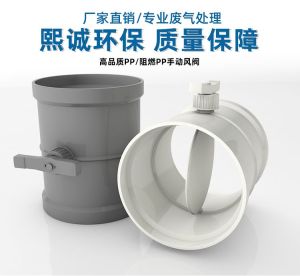
PP Manual Damper
Get Quote
PP Manual Damper / 注塑格栅板系列