
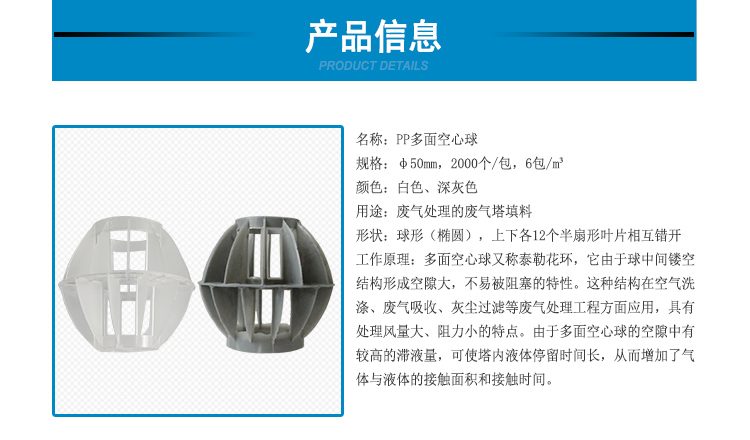
PP Multi-Sphere
| Product Model | Multi-purpose Hollow Ball Packing Series |
|---|---|
| Category | PP Molded Products |
| Reference Price | Price on request |
Product Overview
PP Multi-Sided Ball, also known as Multi-Sided Hollow Ball, is a hollow spherical plastic bulk packing with a hollow center. The ball body is composed of multiple semi-circular blade sections and reinforcing ribs, with an outer contour in the shape of a sphere and an internal hollow structure. The multi-sided balls are randomly piled in scrubbers, absorbers, and purifiers. Waste gas and absorbent flow through the internal and inter-ball gaps, achieving efficient gas-liquid contact and mass transfer.
The hollow structure of the multi-sided hollow ball enables it to have a high void ratio and resistance to blockage. It is suitable for air scrubbing, waste gas absorption, and dust filtration engineering applications with large airflow and low resistance. Due to the high liquid retention in the ball voids, the residence time of the liquid in the packing layer is extended, increasing the contact area and time between the gas and liquid, thereby achieving more thorough waste gas absorption treatment.
The PP Multi-Sided Balls supplied by Xicheng Environmental Protection are molded by polypropylene injection molding, offering acid and alkali resistance, lightweight, and good strength. The blades have elasticity, making them less prone to breakage during installation and operation. The product is available in various ball diameter specifications. Smaller ball diameters provide a larger specific surface area, while larger ball diameters offer higher void ratios and better blockage resistance. They can be selected based on tower diameter, gas volume, and pollutant characteristics, or combined with other packings such as Raschig rings.
Working Principle
The purification principle of multi-sided balls involves the repeated contact between gas and liquid phases on the surface and inside the hollow balls. The absorbent is sprayed from top to bottom, forming liquid films on the ball surfaces and retaining in the internal cavities. Waste gas flows upward through the porous bed formed by a large number of piled balls. The airflow changes direction multiple times within and between the balls, fully contacting the liquid films and retained liquid droplets, capturing pollutants with the absorbent and carrying them down with the liquid flow.
The hollow structure is the key to the high performance of multi-sided balls. The spherical outer contour naturally forms numerous interconnected large voids during packing, ensuring smooth gas channels, low pressure drop, and resistance to blockage by dusty gas. The internal cavity and blades of each ball provide a large specific surface area and liquid retention, with the liquid briefly staying inside the ball, effectively creating numerous micro-reaction spaces in the packing layer, thereby improving absorbent utilization and purification efficiency.
Structural Composition
Each multi-sided ball is formed by the snap-fit of two hemispherical blade structures or molded as a whole. The ball surface is distributed with multiple arc-shaped blades and windows, hollow in the middle, with reinforced nodes formed at the blade intersections. The ball body has no solid wall, allowing gas to enter from any direction. The blades not only increase the film formation area but also guide and disturb the airflow, promoting turbulent gas-liquid contact.
The packing bed is formed by randomly piled multi-sided balls, with point contact between the balls and interconnected voids. It is supported at the bottom by grating plates or porous plates, with the support plate openings smaller than the ball diameter to prevent ball leakage. Due to the spherical shape of the packing, which tends to roll, pressure plates or baffles should be installed above the bed under high gas velocity conditions. Multi-sided balls can be loaded into the entire tower or layered at different heights, with redistributors installed between layers to improve liquid distribution.
Specification Model Table
The following table provides a general comparison of the ball diameter specifications and their applicable characteristics. Specific parameters should be determined by selection calculations.
| Ball Diameter Specification | Performance Characteristics | Applicable Cases |
|---|---|---|
| Small Diameter | Large Specific Surface Area | Clean Gas Efficient Absorption |
| Medium Diameter | Balanced Efficiency and Resistance | General Waste Gas Scrubbing |
| Large Diameter | Large Voids and Blockage Resistance | Dusty Gas Pre-treatment |
Product Features
PP Multi-Sided Balls have a high void ratio, significant liquid retention, and thorough gas-liquid contact, making them an efficient waste gas scrubbing packing. The main features are as follows.
- Hollow and open structure, high void ratio, low ventilation resistance
- Large liquid retention in the ball, extending gas-liquid contact time
- Large blade film formation area, high absorption and purification efficiency
- Large channels resistant to blockage, suitable for dusty gas treatment
- PP injection molded, acid and alkali resistant, with elastic blades
- Spherical packing with good fluidity, easy installation and replacement
- Lightweight, reducing support structure and tower load
| Material | PP Polypropylene |
|---|---|
| Molding Process | Injection Molding |
| Appearance | Hollow Spherical Structure |
| Filling Method | Improperly stacked loading |
| Corrosion resistance performance | Acid-alkali-resistant salt |
| Structural Features | Large gap, large liquid retention |
| Support Component | Grid Plate / Perforated Plate |
| Purpose | Exhaust Gas Absorption Scrubber Packing |
| Color | White / Gray |
| Ball diameter specifications | Multiple diameter options available |
| Stacking Method | Randomly stacked bulk materials |
Application Industries
- Plating and surface treatment acid-alkali exhaust gas scrubber packing
- Chemical acid mist and alkaline gas absorption purification tower packing
- Semiconductor plant ammonia and fluoride-containing exhaust wet treatment packing
- Metallurgical acid pickling and metal smelting flue gas purification packing
- Paint and printing exhaust water washing pre-treatment packing
- Wastewater treatment plant odor gas biological scrubbing packing
- Dust removal and desulfurization tower gas-liquid contact mass transfer packing
Typical Process Location
Multi-faced balls are loaded in the packing section of scrubbing towers and absorption towers, located below the spray nozzles and above the inlet, supported at the bottom by grating plates or porous plates with openings smaller than the ball diameter. Gas flows upward through the multi-faced ball bed, while absorption liquid sprays downward from above, completing gas-liquid countercurrent contact within and between the balls. Cleaned gas is discharged after demisting, and the liquid absorbing pollutants returns to the sump for recycling.
In dust-containing exhaust gas treatment processes, multi-faced balls are often arranged in the pre-washing section, utilizing their large voids and liquid retention characteristics to capture dust and sticky particulates, reducing the risk of blockage in subsequent high-efficiency packing. During loading, balls are evenly poured and leveled through manholes, and a pressure plate is laid on the bed surface to prevent the balls from being carried away by airflow. During maintenance, balls can be removed for cleaning, and damaged or deformed balls are removed and replaced with new ones. Before loading, ensure ball diameter matches the tower diameter and spray density, balls are clean and free of fragments, and are evenly poured and leveled to the design height to avoid localized accumulation affecting gas-liquid distribution. During operation, blockage and breakage are monitored through sight glasses and pressure differentials, and balls are regularly removed for cleaning. Deformed, cracked, and undersized old balls are removed and replaced with new ones in proportion to restore the bed surface smoothness.
Related Products
View More Hot
Hot
PVC Flexible Duct Connector
 Hot
Hot
PVC Plastic Damper
 Hot
Hot
PP plastic ring
 Hot
Hot
PP Manual Damper
Get Quote
PP Manual Damper / Multi-purpose Hollow Ball Packing Series